
Acne may eventually disappear, but the marks and scars it leaves behind can remain for years. For many people, acne scars are more frustrating than the acne itself. They can affect skin texture, make the skin appear uneven, and sometimes affect confidence even after active acne has completely settled.
If you are looking for acne scar treatment in Jaipur, it is important to understand that acne scars are not all the same. A treatment that works well for one type of scar may have little benefit for another. The most effective acne scar treatment therefore begins with identifying the type, depth and pattern of scarring and then selecting a customized combination of procedures.
At Collagen Clinics, Jaipur, acne scar treatment is planned according to the patient’s scar type, skin type, severity of scarring, history of acne and treatment goals. Depending on the individual case, treatment may include microneedling, subcision, fractional CO₂ laser, TCA CROSS, chemical peels, platelet-rich plasma (PRP), scar-specific procedures or combinations of different techniques.
The objective is not to promise unrealistic “100% scar removal.” Instead, the goal is to stimulate skin remodeling, improve texture and make scars significantly less noticeable while maintaining the health and safety of the skin.
What Are Acne Scars?
Acne scars develop when inflammation from acne damages the deeper layers of the skin during the healing process.
Severe or prolonged inflammation can affect collagen and other structural components of the skin. When the skin heals, it may produce either too little or too much tissue.
This can result in:
- Depressed acne scars
- Raised acne scars
- Uneven skin texture
- Persistent pigmentation following acne
People often use the term “acne scar” for any mark that appears after acne, but dermatologists distinguish true acne scars from post-inflammatory pigmentation.
Understanding this difference is essential because the treatments are completely different.
Acne Marks vs Acne Scars
Acne marks
After a pimple heals, it may leave behind a flat brown, grey or red mark.
Dermatologists call these marks post-inflammatory hyperpigmentation or post-inflammatory erythema, depending on their appearance.
They are not the same as structural acne scars.
With appropriate treatment and time, many acne marks gradually fade.
Acne scars
True acne scars involve a change in the texture or structure of the skin.
They may appear as:
- Small deep pits
- Round or oval depressions
- Broad depressions
- Uneven skin texture
- Raised scars
Structural acne scars usually do not disappear simply by using creams.
They often require procedures that stimulate collagen remodeling or release scar tissue beneath the skin.
Types of Acne Scars
The first and most important step in acne scar treatment in Jaipur is accurate scar classification.
1. Ice Pick Scars
Ice pick scars are narrow but deep depressions that extend into the deeper layers of the skin.
They often appear as tiny, sharply defined pits.
Because they are narrow and deep, conventional resurfacing alone may not always provide the desired improvement.
Depending on the individual scar, treatments such as TCA CROSS or other scar-specific techniques may be considered.
2. Boxcar Scars
Boxcar scars are broader depressions with relatively well-defined edges.
They can be shallow or deep and may have:
- Round edges
- Oval edges
- Sharp vertical borders
Dermatologists choose the treatment based on the scar’s depth and whether fibrous bands tether it to deeper tissues.
Potential treatments may include:
- Fractional laser resurfacing
- Microneedling
- Subcision
- Combination treatment
- Other scar-remodeling procedures
3. Rolling Acne Scars
Rolling scars create a wave-like or uneven appearance of the skin.
Fibrous bands beneath the skin often pull rolling scars downward.
When you gently stretch the skin, these scars may appear less noticeable.
Dermatologists often use subcision to release these fibrous attachments and lift the depressed scar.
For more comprehensive improvement, we may combine subcision with other collagen-remodeling treatments based on the patient’s scar type and skin condition.
4. Mixed Acne Scars
Most patients do not have only one type of acne scar.
A person may have:
- Ice pick scars
- Boxcar scars
- Rolling scars
- Pigmentation
all at the same time.
This is why a single treatment cannot always provide the best possible result.
A customized combination approach is often more appropriate for mixed acne scarring.
5. Raised Acne Scars
Some people develop raised scars rather than depressed scars.
These can occur particularly on the:
- Chest
- Shoulders
- Back
- Jawline
Raised acne scars require a different treatment strategy from depressed acne scars.
Depending on the diagnosis, treatments may include intralesional medications, pressure-based approaches or other scar-specific treatments.
It is important to distinguish hypertrophic scars from keloids because management can differ.
Why Do Acne Scars Develop?
Not everyone with acne develops significant scars.
The risk is influenced by several factors.
Severity of acne
Deep inflammatory acne and nodulocystic acne have a greater risk of scarring.
Duration of inflammation
The longer severe inflammation remains uncontrolled, the greater the potential for permanent structural damage.
Picking and squeezing
Repeatedly squeezing pimples can increase tissue trauma and inflammation.
Genetics
Some people have a greater tendency to develop significant scarring.
Delayed acne treatment
Persistent untreated inflammatory acne can continue damaging the skin.
This is one reason why early acne treatment is also acne-scar prevention.
Acne Scar Treatment in Jaipur
There is no universal “best acne scar treatment.”
The appropriate treatment depends on:
- Scar type
- Scar depth
- Skin type
- Degree of pigmentation
- Presence of active acne
- Previous procedures
- Age of the scars
- Patient expectations
- Downtime that the patient can accept
A dermatologist may recommend one procedure or a combination of several treatments.
The most commonly considered approaches include microneedling, subcision, fractional CO₂ laser, TCA CROSS, chemical peels and PRP, depending on the individual case.
1. Microneedling for Acne Scars
Microneedling uses fine sterile needles to create controlled micro-injuries in the skin.
These micro-injuries stimulate the skin’s wound-healing response and encourage collagen remodeling.
Over a series of treatments, microneedling may improve:
- Mild to moderate depressed scars
- Uneven skin texture
- Overall skin smoothness
Microneedling is particularly useful when the scars are relatively shallow.
The number of sessions required varies between patients.
Treatment is usually performed as a series rather than expecting complete correction after a single session.
2. Subcision for Acne Scars
Dermatologists often use subcision to treat depressed acne scars, especially rolling scars caused by fibrous bands beneath the skin.
Some depressed scars are attached to deeper tissue by fibrous bands.
These attachments can pull the skin downward and create a depression.
During subcision, the dermatologist carefully guides a specialized needle or instrument beneath the scar to release the fibrous bands that tether the skin.
Once the tethering is released, the depressed skin can become more elevated.
Subcision may be performed alone or combined with other treatments such as:
- Microneedling
- Fractional laser
- PRP
- Other collagen-remodeling procedures
Subcision is not required for every acne scar. It is particularly useful when tethering is an important component of the scar.
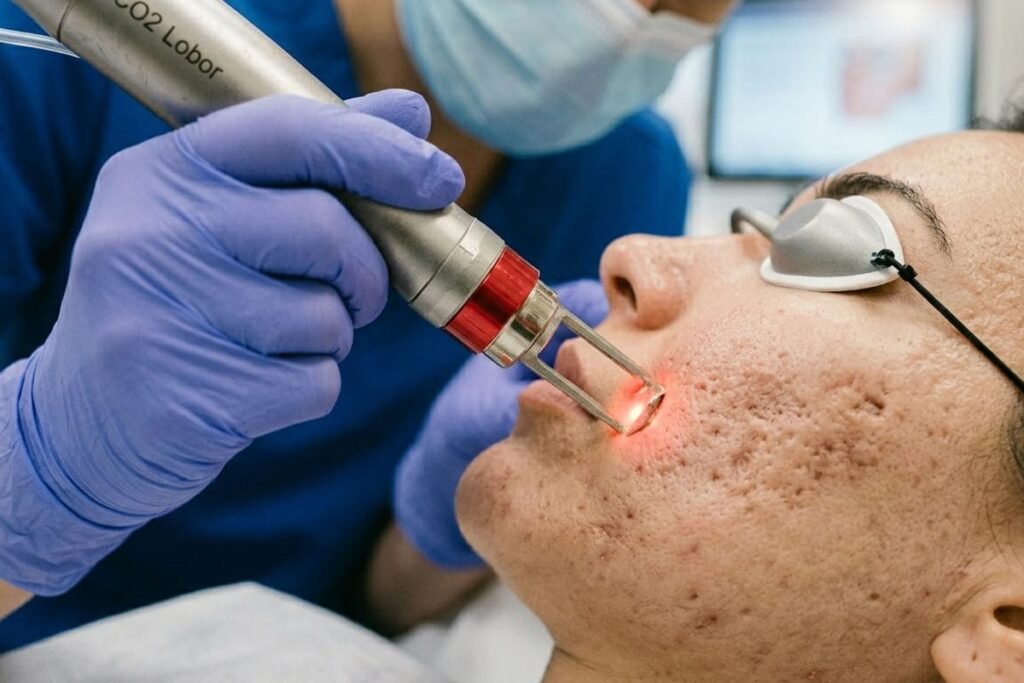
3. Fractional CO₂ Laser for Acne Scars
Fractional CO₂ laser is a resurfacing treatment that creates microscopic columns of controlled thermal injury within the skin.
The healing process stimulates collagen remodeling and can improve the appearance of selected acne scars and uneven skin texture.
It may be considered for:
- Boxcar scars
- Some rolling scars
- Uneven texture
- Certain mixed acne scars
The intensity of treatment is adjusted according to the patient’s skin type, scar severity and tolerance for downtime.
Because darker skin types may have a greater risk of post-inflammatory pigmentation following certain laser treatments, appropriate patient selection and settings are important.
An experienced medical professional should perform fractional laser treatment after assessing the patient’s skin type, scar pattern and individual treatment needs rather than using a one-size-fits-all approach.
4. TCA CROSS for Ice Pick Scars
During TCA CROSS, the dermatologist precisely applies a high-concentration trichloroacetic acid solution to selected deep acne scars to stimulate collagen remodeling.
It is particularly considered for ice pick scars and certain narrow deep scars.
The objective is to stimulate remodeling within the scar.
TCA CROSS is not the same as applying a conventional chemical peel over the entire face.
Because TCA CROSS uses a high concentration of acid and requires precise application, an appropriately trained dermatologist should perform the procedure.
5. Chemical Peels for Acne Scars and Marks
Chemical peels can be useful in selected patients, particularly when acne scars are accompanied by:
- Post-inflammatory pigmentation
- Mild textural irregularity
- Active acne
Different peeling agents have different effects and indications.
Chemical peels may help improve the appearance of pigmentation and superficial textural changes, but they cannot replace scar-specific procedures for deep structural scars.
For this reason, chemical peels are often used as one component of a broader treatment strategy.
6. PRP for Acne Scar Treatment
Platelet-rich plasma, commonly called PRP, uses a patient’s own blood to prepare a platelet-rich concentrate.
PRP may be used as an adjunct to selected acne scar procedures.
The growth factors and mediators present in platelets may support the tissue-healing process.
PRP may be combined with procedures such as:
- Microneedling
- Subcision
- Fractional laser
However, PRP is not a universal replacement for scar-specific treatment.
The decision to use PRP depends on the patient’s scar type and the overall treatment plan.
7. Combination Treatment for Acne Scars
For many patients, the best approach is not one procedure but a combination treatment plan.
For example, a patient with mixed acne scars may require:
Rolling scars → Subcision
Ice pick scars → TCA CROSS
Boxcar scars → Fractional resurfacing
Mild textural changes → Microneedling
Pigmentation → Appropriate topical treatment or chemical peel
The combination is selected based on the individual’s actual scar pattern.
This approach is one of the most important principles in modern acne scar management.
Can Acne Scars Be Completely Removed?
This is one of the most common questions patients ask.
The honest answer is that acne scar treatment generally aims for significant improvement rather than guaranteed complete removal.
The depth and duration of scarring, skin type, healing response and scar pattern all influence the outcome.
Some shallow scars may become much less noticeable.
Deep scars may improve considerably but may still remain partially visible.
It is therefore better to approach acne scar treatment with realistic expectations.
The goal is to make the scars less deep, less visible and the overall skin texture smoother and more even.
How Many Sessions Are Required for Acne Scar Treatment?
The number of sessions varies significantly.
It depends on:
- Type of scar
- Severity
- Depth
- Skin type
- Procedure selected
- Response to previous treatments
Many collagen-remodeling procedures are performed as a series of sessions because collagen remodeling takes time.
For some patients, improvement may be visible after the first treatment, while others require several sessions for meaningful improvement.
A dermatologist can provide a more realistic estimate after examining the scars in person.
How Long Does It Take to See Results?
Acne scar treatment does not produce instant collagen remodeling.
Some immediate improvement may occur because of temporary swelling or changes in skin hydration, but true scar remodeling develops gradually.
Collagen formation and restructuring can continue for weeks to months following treatment.
This is why patients should avoid judging the final outcome immediately after a procedure.
Photographic comparison under standardized lighting can be particularly useful when assessing gradual improvement.
Is Acne Scar Treatment Painful?
Most procedures can be made reasonably comfortable with appropriate preparation.
Depending on the procedure, a dermatologist may use:
- Topical anesthetic
- Cooling
- Appropriate pain-control measures
Temporary redness, swelling, sensitivity or crusting may occur depending on the treatment.
The recovery period varies significantly between procedures.
Recovery After Acne Scar Treatment
Recovery depends on the procedure performed.
After treatment, patients may experience:
- Redness
- Mild swelling
- Sensitivity
- Dryness
- Peeling
- Temporary darkening or crusting in some procedures
Post-treatment skincare is important.
Patients are generally advised to:
- Follow the prescribed aftercare
- Avoid unnecessary irritation
- Avoid picking or scratching treated areas
- Protect the skin from ultraviolet exposure
- Use sunscreen appropriately
- Avoid adding unapproved active ingredients during recovery
Your dermatologist will provide procedure-specific aftercare instructions.
Acne Scar Treatment for Indian Skin
Indian skin can be more prone to post-inflammatory hyperpigmentation after inflammation or certain procedures.
Therefore, acne scar treatment needs to be individualized according to skin type and pigmentation tendency.
This is particularly important when considering:
- Fractional lasers
- Chemical peels
- Aggressive resurfacing procedures
The strongest treatment is not necessarily the best treatment.
The objective is to achieve meaningful scar improvement while minimizing the risk of unwanted pigmentation or other complications.
When Should Acne Scar Treatment Begin?
Ideally, acne scar management should begin after active inflammatory acne is reasonably controlled.
If new painful acne continues to develop every week, treating scars alone may not solve the underlying problem.
The sequence is often:
Step 1: Control active acne
Step 2: Prevent new acne and scarring
3rd Step: Assess the established scar pattern
Step 4: Choose scar-specific treatments
Step 5: Perform combination procedures where appropriate
6th Step: Maintain the results and prevent new scars
Therefore, effective care should first control active acne and then target the scars it has left behind.
How to Prevent Acne Scars
Prevention is easier than treating established scars.
You can reduce the risk by:
Treating inflammatory acne early
Do not wait until acne becomes severe.
Avoiding picking
Repeated manipulation can worsen inflammation and increase the risk of pigmentation and scarring.
Following treatment consistently
Stopping acne medication as soon as the skin improves may allow acne to return.
Using appropriate skincare
Avoid excessive scrubbing and irritating home remedies.
Seeking professional treatment for severe acne
Nodules, cysts and persistent inflammatory acne deserve dermatological assessment.
Why Choose Dr Priyanka Sharma for Acne Scar Treatment in Jaipur?
Acne scar treatment requires more than simply selecting a machine.
At Collagen Clinics, treatment begins with clinical assessment of the scar pattern and skin type.
We design the treatment plan around the patient’s individual needs rather than recommending the same procedure to everyone.
Individual scar assessment
Different scars require different treatments.
Evidence-based dermatology
Dermatologists select treatment options according to established dermatological principles.
Combination treatment when appropriate
Dermatologists can combine multiple techniques when patients have different types of acne scars.
Focus on skin safety
We adapt the treatment intensity and procedure selection to the patient’s skin type and pigmentation risk.
Long-term approach
The aim is not only to improve existing scars but also to prevent new scars by controlling active acne.
Acne Scar Treatment in Jaipur – Frequently Asked Questions
What is the best acne scar treatment in Jaipur?
There is no single best treatment for every acne scar. The most appropriate treatment depends on whether you have ice pick, rolling, boxcar or mixed scars. A combination of procedures may be recommended.
Which treatment is best for deep acne scars?
Deep acne scars require individualized treatment. Rolling scars may benefit from subcision, while narrow deep scars may be considered for TCA CROSS. Some boxcar scars may respond to resurfacing procedures.
Is CO₂ laser good for acne scars?
Fractional CO₂ laser can improve selected acne scars and uneven skin texture. However, it is not suitable for every scar type and may need to be combined with other procedures.
Is microneedling effective for acne scars?
Microneedling can improve selected shallow to moderate depressed scars by stimulating collagen remodeling. Multiple sessions may be required.
Is subcision permanent?
Subcision releases fibrous attachments beneath selected depressed scars. Treatment can provide long-lasting improvement, although acne scars may not disappear completely and patients may require additional treatments.
Can acne scars be removed permanently?
Complete removal cannot be guaranteed. Appropriate treatment can significantly reduce the visibility and depth of many scars.
How many sessions are required?
The number varies depending on scar type, severity and treatment method. Many patients require multiple sessions spaced appropriately apart.
Can acne scars be treated if I still have acne?
We generally control active acne before performing intensive scar procedures. Otherwise, new acne can continue creating new scars.
Does acne scar treatment hurt?
We can perform most procedures with appropriate numbing and comfort measures. Temporary discomfort, redness or swelling may occur.
Can acne scars come back?
A treated scar does not typically “come back” in the same way as active acne. However, new acne can create new scars. Long-term acne control is therefore important.
Can acne scars be treated in darker Indian skin?
Yes, but we must carefully select and individualize the treatment because some procedures can increase the risk of post-inflammatory pigmentation.
Is PRP necessary for acne scar treatment?
Not necessarily. We can use PRP as an adjunct in selected cases, but we do not require it for every acne scar patient.
Are acne scar treatments safe?
When a trained professional appropriately selects and performs acne scar procedures, we can perform them safely. However, every procedure carries potential risks, so we should individualize the treatment.
Acne Scar Treatment Cost in Jaipur
The cost of acne scar treatment in Jaipur varies considerably because we use different procedures based on each patient’s individual needs.
Factors that influence the cost include:
- Type of acne scars
- Severity and depth
- Number of areas being treated
- Procedure selected
- Number of sessions required
- Whether combination treatment is required
- Technology used
- Doctor’s expertise
- Post-procedure care
For example, the treatment plan for a patient with mild rolling scars may be very different from that of someone with deep mixed ice-pick, boxcar and rolling scars.
Therefore, quoting one fixed price for “acne scar treatment” without examining the scars can be misleading.
A personalized consultation is the best way to determine which procedures are appropriate and estimate the overall treatment plan.
What Makes a Good Acne Scar Treatment Plan?
A good acne scar treatment plan should answer five questions:
1. What type of scars do I have?
Ice pick, boxcar, rolling, hypertrophic or mixed?
2. How deep are the scars?
Shallow scars may respond differently from deep scars.
3. Is active acne controlled?
If not, acne treatment should be addressed first.
4. What is my skin type and pigmentation risk?
This influences the choice and intensity of procedures.
5. What is a realistic outcome?
The aim should be measurable improvement, not unrealistic promises of complete scar removal.
Take the First Step Towards Smoother Skin
Acne scars can be stubborn, but they are treatable.
The key is to stop thinking of acne scars as a single condition. Every scar has a structure, and every structure may require a different treatment approach.
If you are looking for acne scar treatment in Jaipur, an experienced dermatologist can assess your skin, identify the type of scarring and create a treatment plan suited to your individual needs.
At Collagen Clinics, Jaipur, acne scar management focuses on personalized treatment, appropriate combination procedures, skin safety and realistic improvement.
Whether you have rolling scars, boxcar scars, ice pick scars, acne marks or a combination of different types, the first step is a proper dermatological assessment.
Book an Acne Scar Consultation in Jaipur
Dr Priyanka Sharma
MBBS, MD Dermatology
Dermatologist & Aesthetic Physician
Jaipur
If acne is still active, treating the acne itself should be the first step. Once new breakouts are controlled, a personalized acne scar treatment plan can be designed to improve skin texture and reduce the visibility of established scars.
Clearer skin is not about finding one “magic” procedure. It is about choosing the right treatment for the right scar, at the right time.
Related Services
- Acne Treatment in Jaipur
- Acne Doctor in Jaipur
- Pimple Treatment in Jaipur
- Acne Marks Treatment in Jaipur
- Hormonal Acne Treatment in Jaipur
- Chemical Peel in Jaipur
- Microneedling for Acne Scars
- Fractional CO₂ Laser for Acne Scars
- Subcision for Acne Scars
- TCA CROSS for Ice Pick Scars
- Laser Skin Resurfacing in Jaipur
Medical Disclaimer
The information provided on this page is for general educational purposes and does not replace an individual consultation with a qualified dermatologist. Acne scar treatment should be selected after assessing the scar type, skin type, medical history, active acne and individual treatment goals. Results vary between individuals, and complete scar removal cannot be guaranteed.