
Alopecia areata treatment in Jaipur is sought by people who suddenly develop one or more smooth, round patches of hair loss on the scalp, beard, eyebrows, eyelashes or other parts of the body. Unlike common hair fall caused by nutritional deficiencies, stress or androgenetic alopecia, alopecia areata is an autoimmune condition in which the immune system mistakenly attacks hair follicles.
The condition can occur at any age and may affect both men and women. Hair loss can range from a few small patches to extensive loss involving the scalp or entire body.
At Collagen Clinics, Jaipur, Dr Priyanka Sharma evaluates alopecia areata by assessing the pattern and extent of hair loss, examining the scalp and hair follicles, identifying possible associated conditions and selecting treatment according to the severity and individual needs of the patient.
Importantly, alopecia areata is treatable, but the course can be unpredictable. Some patients experience spontaneous hair regrowth, while others may require prolonged medical treatment and follow-up.
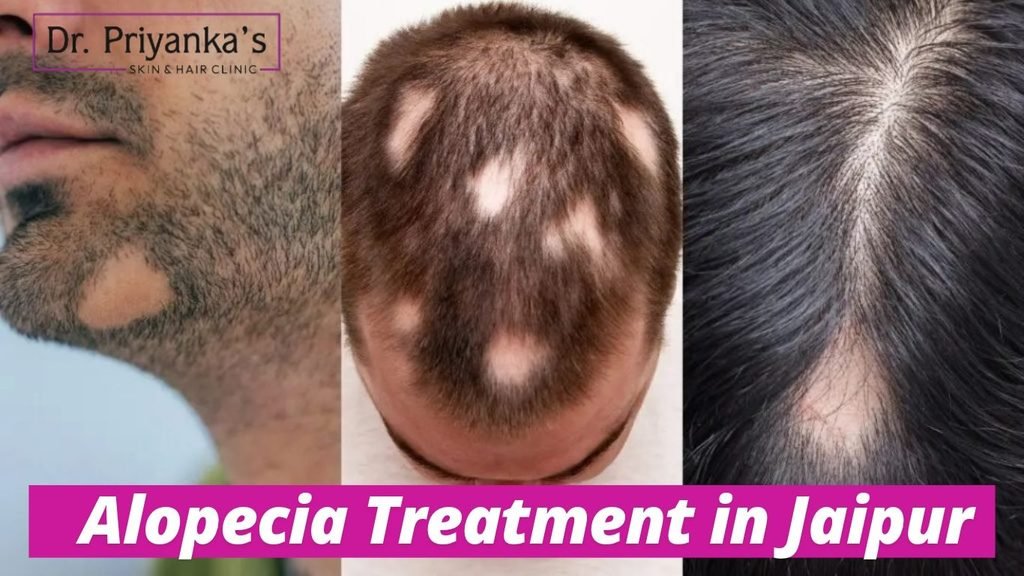
What Is Alopecia Areata?
Alopecia areata is an autoimmune form of hair loss that typically causes sudden, well-defined patches of hair loss.
The affected skin usually appears normal and does not develop scarring. This is important because alopecia areata is generally considered a non-scarring alopecia, meaning that the hair follicles are usually preserved and can potentially produce hair again.
It can affect:
- Scalp hair
- Beard
- Eyebrows
- Eyelashes
- Moustache
- Body hair
The most common presentation is one or more round or oval patches of hair loss on the scalp.
Some patients may have only a small patch that regrows completely, while others may develop recurrent or more extensive disease.
What Causes Alopecia Areata?
The exact cause of alopecia areata is not completely understood.
It occurs when the immune system mistakenly targets structures around the hair follicle. Genetic susceptibility, immune factors and environmental triggers may all contribute.
Possible factors associated with alopecia areata include:
- Genetic predisposition
- Immune system dysregulation
- Certain autoimmune conditions
- Emotional or physical stress in some patients
- Infections or other environmental triggers in susceptible individuals
However, it is important to understand that stress is not necessarily the sole cause of alopecia areata.
Many patients develop alopecia areata without any identifiable trigger.
Is Alopecia Areata an Autoimmune Disease?
Yes.
Alopecia areata is considered an autoimmune disease in which the immune system attacks hair follicles.
The inflammatory process disrupts the normal hair-growth cycle and causes affected hairs to enter the resting or shedding phase prematurely.
Because the follicle itself is generally not destroyed, hair regrowth remains possible.
This is one of the major differences between alopecia areata and many forms of permanent scarring hair loss.
What Does Alopecia Areata Look Like?
The classic appearance of alopecia areata is:
- Sudden hair loss
- Round or oval bald patches
- Smooth skin within the patch
- No obvious scaling
- No scarring
- Normal-looking skin in many cases
Some patients develop characteristic “exclamation mark hairs”, where hairs near the edge of a patch become narrower toward the scalp.
Short broken hairs or black dots may also be visible.
A dermatologist may use dermoscopy/trichoscopy to examine the scalp and hair follicles more closely.
Can Alopecia Areata Affect the Beard?
Yes.
Beard alopecia areata is relatively common in men.
It may appear as one or more sharply defined bald patches in the beard area, chin, moustache or jawline.
Patients sometimes mistake beard alopecia areata for a fungal infection. However, the two conditions require different treatment.
A dermatologist can distinguish between them through clinical examination and dermoscopy, and fungal testing may be considered when appropriate.
Can Alopecia Areata Affect Eyebrows and Eyelashes?
Yes.
Alopecia areata can affect eyebrows and eyelashes, particularly in more extensive disease.
Loss of eyebrow or eyelash hair can be particularly distressing because it is highly visible.
Treatment needs to be carefully selected in these sensitive areas, and patients should avoid applying prescription medicines near the eyes without medical supervision.
Types of Alopecia Areata
Alopecia areata can occur in different patterns.
Patchy Alopecia Areata
This is the most common form.
Patients develop one or more localized patches of hair loss.
Alopecia Totalis
In alopecia totalis, hair loss involves the entire scalp.
Alopecia Universalis
Alopecia universalis is a more extensive form in which hair may be lost from the scalp and most or all other body sites.
Ophiasis Pattern
In the ophiasis pattern, hair loss predominantly affects the sides and back of the scalp.
The type and extent of alopecia areata can influence treatment decisions and prognosis.
Alopecia Areata Diagnosis
Alopecia areata is usually diagnosed clinically by a dermatologist.
During consultation, the doctor may assess:
- Pattern of hair loss
- Number and size of patches
- Duration of disease
- Rate of progression
- Previous episodes
- Family history
- Associated autoimmune conditions
- Nail changes
- Hair loss elsewhere on the body
Dermoscopy for Alopecia Areata
Dermoscopy or trichoscopy can provide useful information when diagnosing alopecia areata.
Features that may support the diagnosis include:
- Yellow dots
- Black dots
- Exclamation mark hairs
- Short regrowing hairs
- Broken hairs
- Tapering hairs
Dermoscopy can also help differentiate alopecia areata from other causes of patchy hair loss.
Is a Blood Test Needed for Alopecia Areata?
Not every patient with alopecia areata requires extensive blood testing.
Investigations should be guided by the patient’s history and examination.
Blood tests may sometimes be considered when there are symptoms or clinical findings suggesting another condition, such as thyroid disease or nutritional deficiency.
The important principle is that testing should be individualized rather than ordering every possible investigation for every patient.
Alopecia Areata Treatment in Jaipur
The treatment of alopecia areata depends on:
- Patient’s age
- Number of patches
- Size of affected areas
- Duration of disease
- Rate of progression
- Involvement of eyebrows or eyelashes
- Previous treatment
- Extent of hair loss
- Presence of associated medical conditions
There is no single treatment that works equally well for every patient.
For small, localized patches, dermatologists may use intralesional corticosteroid injections or topical treatments. More extensive or rapidly progressing disease may require systemic treatment.
Intralesional Steroid Injections for Alopecia Areata
Intralesional corticosteroid injections are an established treatment option for selected patients with localized alopecia areata.
A small amount of corticosteroid is injected directly into the affected areas.
The objective is to reduce the abnormal immune activity around the hair follicles and encourage hair regrowth.
This treatment is particularly useful when there are a limited number of patches.
Multiple treatment sessions may be required depending on the response.
Because injections need to be placed at an appropriate depth and concentration, they should be performed by a dermatologist experienced in treating alopecia areata.
Possible adverse effects include:
- Temporary discomfort
- Skin thinning
- Small depressions
- Changes in pigmentation
- Rarely, other local steroid-related effects
Appropriate technique helps minimize complications.
Topical Treatment for Alopecia Areata
Topical medicines may be used in selected patients.
Depending on the patient’s age, location and severity of disease, a dermatologist may consider:
- Topical corticosteroids
- Topical immunotherapy in selected cases
- Other prescription treatments
The choice depends on the clinical situation.
Topical treatment may be particularly relevant for children or for areas where injections are difficult.
Patients should not self-medicate with potent steroid creams because inappropriate or prolonged use can cause skin thinning and other complications.
JAK Inhibitors for Alopecia Areata
For moderate-to-severe alopecia areata, particularly when a significant proportion of the scalp is affected, Janus kinase (JAK) inhibitors have become an important treatment option.
JAK-STAT signaling is involved in the inflammatory pathways associated with alopecia areata, and JAK inhibitors can suppress these pathways.
Depending on regulatory approvals, patient characteristics and clinical circumstances, medications in this category may be considered for appropriate patients.
These medicines require careful medical evaluation and monitoring because they can have significant systemic adverse effects and are not suitable for everyone.
A dermatologist should assess factors such as:
- Age
- Disease severity
- Duration
- Other medical conditions
- Infection risk
- Pregnancy considerations
- Previous treatments
- Laboratory parameters
Treatment decisions should always be individualized.
Can Alopecia Areata Be Cured Permanently?
Alopecia areata can improve significantly and hair may regrow completely, particularly in patients with limited disease.
However, it is important to understand that alopecia areata can be recurrent.
A patient may experience complete hair regrowth and later develop another episode.
Therefore, the goal of treatment is not only to encourage regrowth but also to monitor disease activity and identify recurrence early.
How Long Does Hair Take to Regrow?
Hair regrowth does not occur immediately after treatment.
Once the autoimmune activity around the follicle is controlled, hair follicles may gradually restart the growth cycle.
The time required varies between patients.
Initially, new hairs may appear:
- Fine
- Short
- Light in colour
- Soft in texture
They may gradually become thicker and more pigmented as growth continues.
Therefore, patients should generally allow sufficient time for treatment response before deciding that a treatment has failed.
Can Alopecia Areata Cause Permanent Hair Loss?
Alopecia areata generally does not permanently destroy hair follicles.
However, extensive or long-standing disease may be more difficult to treat and may have a lower likelihood of complete regrowth.
Some patients may also experience nail changes or recurrent episodes.
The prognosis depends on factors including the extent and pattern of hair loss, duration of disease and individual response to treatment.
Does Stress Cause Alopecia Areata?
Stress is frequently discussed in relation to alopecia areata.
Some patients report significant emotional or physical stress before developing a patch of hair loss. However, alopecia areata is an autoimmune condition and should not be reduced to simply “stress-related hair loss.”
Stress management may be beneficial for overall wellbeing, but treating the underlying autoimmune process remains important.
Patients should not be blamed for developing alopecia areata because of their lifestyle or emotional state.
Alopecia Areata vs Fungal Infection
Patchy hair loss can sometimes be caused by tinea capitis, a fungal infection of the scalp.
This is particularly important in children.
Fungal infection may be associated with:
- Scaling
- Itching
- Broken hairs
- Inflammation
- Tenderness
- Enlarged lymph nodes in some cases
Alopecia areata generally produces smooth patches without the typical scaling of a fungal infection.
Because treatment is completely different, an accurate diagnosis is essential.
Alopecia Areata vs Male Pattern Hair Loss
Alopecia areata and androgenetic alopecia are different conditions.
Male pattern hair loss usually causes gradual thinning over the:
- Hairline
- Temples
- Crown
Alopecia areata typically causes sudden, localized patches.
The treatment approach is therefore different.
If you suddenly notice a smooth bald patch, do not assume that it is ordinary male pattern hair loss.
Can Diet Cause Alopecia Areata?
Alopecia areata is not simply caused by a lack of a particular food or vitamin.
However, nutritional deficiencies may contribute to other types of hair loss and can coexist with alopecia areata.
A balanced diet is important for overall hair health.
Supplements should ideally be taken when a deficiency has been identified or when a doctor recommends them.
Taking multiple “hair vitamins” without medical evaluation does not necessarily improve alopecia areata.
Alopecia Areata in Children
Children can develop alopecia areata.
Parents may suddenly notice a round bald patch while combing or washing the child’s hair.
It is important not to panic.
A dermatologist can assess the child and distinguish alopecia areata from:
- Tinea capitis
- Hair-pulling disorders
- Traction alopecia
- Other causes of patchy hair loss
Treatment is selected according to the child’s age and severity of disease.
Alopecia Areata and Other Autoimmune Conditions
Alopecia areata may occur along with certain autoimmune conditions.
Depending on the clinical history, a dermatologist may ask about:
- Thyroid disease
- Vitiligo
- Atopic conditions
- Other autoimmune disorders
However, this does not mean every patient with alopecia areata has another autoimmune disease.
Evaluation should be based on symptoms and clinical findings.
Nail Changes in Alopecia Areata
Some patients with alopecia areata develop nail changes.
These can include:
- Tiny pits
- Roughness
- Ridging
- Brittleness
- Other changes in nail texture
Nail involvement can sometimes be associated with more extensive disease.
Therefore, a complete examination may include looking at the nails as well as the scalp.
What Should You Avoid If You Have Alopecia Areata?
Patients with sudden patchy hair loss should avoid:
- Aggressive scalp massage
- Scratching the affected area
- Unregulated hair-growth products
- Home remedies involving strong chemicals
- Excessive application of essential oils
- Unsupervised steroid creams
- Delaying diagnosis because the patch is assumed to be fungal infection
- Repeatedly changing treatments without medical advice
Hair follicles affected by alopecia areata are already undergoing an abnormal immune process. Irritating the scalp is unlikely to solve the problem.
Can PRP Treat Alopecia Areata?
PRP is widely discussed as a treatment for hair loss, but alopecia areata is different from androgenetic hair loss.
PRP may have been investigated in alopecia areata, but it should not automatically be considered a first-line treatment for every patient.
The choice of treatment should be based on the diagnosis, disease severity and available evidence.
If you have patchy hair loss, it is better to establish the diagnosis first rather than proceeding directly to a cosmetic hair treatment.
Is Hair Transplant Needed for Alopecia Areata?
Usually, no.
Hair transplantation is generally not the first-line treatment for active alopecia areata because the autoimmune process can potentially affect transplanted follicles as well.
Patients with alopecia areata should first undergo appropriate medical assessment and treatment.
Hair transplantation may only be discussed in very specific circumstances after prolonged stability and specialist evaluation.
Alopecia Areata Treatment Cost in Jaipur
The cost of alopecia areata treatment in Jaipur varies considerably because treatment depends on the extent and severity of the disease.
Factors that can influence treatment cost include:
- Number of affected patches
- Size of the affected area
- Type of treatment
- Number of treatment sessions
- Whether injections are required
- Whether systemic treatment is required
- Investigations when clinically indicated
- Duration of follow-up
For this reason, it is difficult to give one fixed treatment price without examining the patient.
A consultation with a dermatologist can help determine the diagnosis and create an individualized treatment plan.
Why Choose Collagen Clinics for Alopecia Areata Treatment in Jaipur?
At Collagen Clinics, Jaipur, the approach to alopecia areata focuses on accurate diagnosis, evidence-based treatment and individualized follow-up.
Dr Priyanka Sharma evaluates the pattern and severity of hair loss before recommending treatment.
Depending on the presentation, management may include medical treatment, intralesional therapy, topical treatment or other appropriate options.
The aim is not simply to prescribe a hair-growth product but to determine why the hair is falling out and which treatment is most appropriate for that particular patient.
When Should You See a Dermatologist for Hair Loss?
You should consider a dermatology consultation if you notice:
- A sudden bald patch
- Round patches of scalp hair loss
- Sudden beard hair loss
- Loss of eyebrows or eyelashes
- Rapidly increasing patches
- Recurrent episodes of patchy hair loss
- Hair loss associated with nail changes
- Hair loss in a child
- Scalp changes associated with patchy hair loss
Early assessment can help establish the diagnosis and allow appropriate treatment to begin sooner.
Frequently Asked Questions
1. What is the best treatment for alopecia areata?
Treatment depends on the severity and extent of the disease. Localized alopecia areata may be treated with intralesional corticosteroids or topical therapy, while extensive disease may require systemic treatment such as appropriate JAK-inhibitor therapy.
2. Can alopecia areata grow back naturally?
Yes. Some patients experience spontaneous hair regrowth, particularly when the disease is limited. However, recurrence is possible.
3. Is alopecia areata contagious?
No. Alopecia areata is not an infection and cannot spread from one person to another.
4. Can alopecia areata be caused by a fungal infection?
No. Alopecia areata is an autoimmune condition. However, fungal infections can also cause patchy hair loss and should be distinguished from alopecia areata.
5. Does alopecia areata affect beard hair?
Yes. Alopecia areata can cause sharply defined bald patches in the beard and moustache.
6. Can alopecia areata affect eyebrows?
Yes. Eyebrow and eyelash involvement can occur, particularly in more extensive disease.
7. Does alopecia areata cause permanent baldness?
Not usually. The condition is generally non-scarring, and hair regrowth is possible. However, extensive or long-standing disease can be more difficult to treat.
8. Is steroid injection effective for alopecia areata?
Intralesional corticosteroids can be effective for selected patients with localized alopecia areata. They should be administered by a trained dermatologist to reduce the risk of local side effects.
9. Is JAK inhibitor treatment suitable for everyone?
No. JAK inhibitors are systemic medicines with important safety considerations. A dermatologist must determine whether the benefits outweigh the risks for an individual patient.
10. Can alopecia areata come back after treatment?
Yes. Recurrence is possible even after complete hair regrowth.
11. Is PRP required for alopecia areata?
No. PRP is not automatically required for alopecia areata. The treatment should be selected according to the diagnosis and severity of disease.
12. Which doctor treats alopecia areata in Jaipur?
A dermatologist is the appropriate specialist for diagnosing and treating alopecia areata. At Collagen Clinics, Dr Priyanka Sharma evaluates patients with patchy hair loss and provides individualized treatment based on the clinical presentation.
Conclusion
Alopecia areata is a treatable autoimmune form of hair loss that can affect the scalp, beard, eyebrows, eyelashes and other body hair.
Although the condition may appear suddenly and can be emotionally distressing, it does not necessarily mean that the hair loss will be permanent.
Early diagnosis is important because alopecia areata can resemble other forms of patchy hair loss, including fungal infection. Once the diagnosis is confirmed, treatment can be selected according to the extent and severity of disease.
For localized disease, treatments such as intralesional corticosteroid injections and topical therapy may be appropriate. Patients with more extensive disease may require systemic treatment, including newer targeted therapies when clinically suitable.
Most importantly, treatment should be individualized rather than based on a one-size-fits-all approach.
If you have suddenly developed a bald patch on your scalp, beard or eyebrows, consider consulting a dermatologist rather than waiting for the condition to progress.
For alopecia areata diagnosis and treatment in Jaipur, consult Dr Priyanka Sharma at Collagen Clinics.