
Bullous pemphigoid is a rare autoimmune skin condition that causes large, fluid-filled blisters, intense itching, redness and inflammation of the skin. It commonly affects older adults, although it can occasionally occur in younger individuals. The condition develops when the body’s immune system mistakenly attacks proteins that help attach the outer layer of skin to the underlying layer, resulting in separation of the skin layers and blister formation.
If you or a family member is experiencing recurrent skin blisters, persistent itching or unexplained fluid-filled eruptions, timely dermatological evaluation is important. Early diagnosis and appropriate treatment can help control inflammation, prevent new blisters and reduce complications.
Dr Priyanka Sharma, Dermatologist in Jaipur, provides evaluation and medical management of autoimmune skin diseases, including bullous pemphigoid, with an individualised approach based on disease severity, age, general health and associated medical conditions.
If you are looking for bullous pemphigoid treatment in Jaipur, understanding the condition, its symptoms and available treatment options is the first step towards effective disease management.
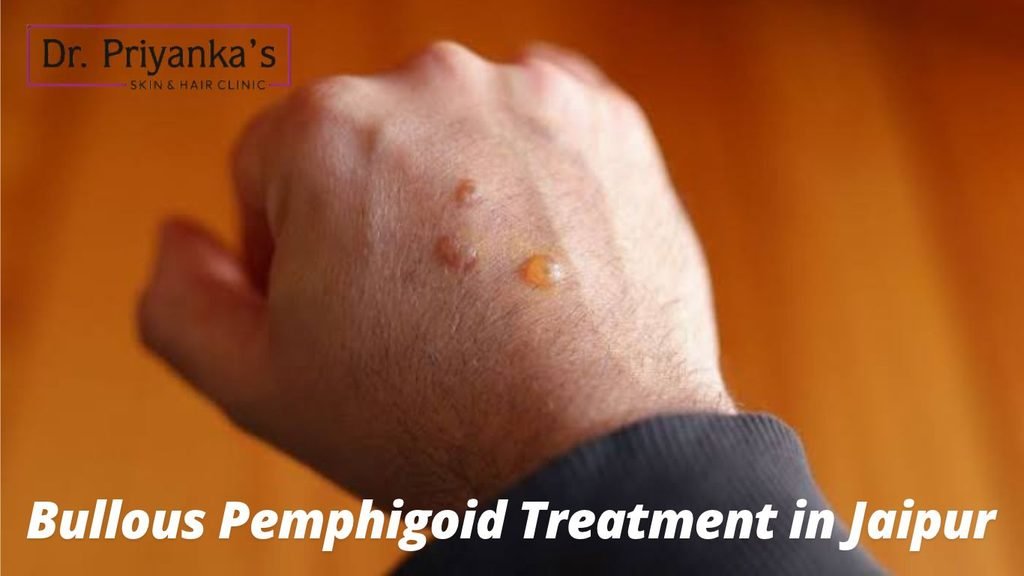
What Is Bullous Pemphigoid?
Bullous pemphigoid is a chronic autoimmune blistering disorder that primarily affects the skin. It occurs when the immune system produces antibodies against specific proteins located at the dermoepidermal junction, the area connecting the epidermis (outer skin layer) with the dermis (deeper skin layer).
The two major target proteins are:
- BP180 (type XVII collagen)
- BP230 (a component of the hemidesmosomal plaque)
These proteins play an essential role in maintaining the attachment between different skin layers.
When antibodies attack these proteins, inflammation develops and causes separation between the epidermis and dermis. This results in the formation of tense, fluid-filled blisters.
Bullous pemphigoid is not contagious. It cannot spread through physical contact, sharing clothes or being around an affected person.
Although it is most frequently seen in people above 60 years of age, it can occur at other ages as well.
Symptoms of Bullous Pemphigoid
The symptoms of bullous pemphigoid may develop gradually or appear relatively suddenly. In many patients, itching starts several weeks before visible blisters develop.
Common symptoms include:
1. Intense Itching
Persistent itching is often one of the earliest symptoms. Some patients experience severe itching even before any blisters appear.
2. Large Fluid-Filled Blisters
The characteristic feature is the development of tense blisters filled with clear or occasionally blood-tinged fluid.
These blisters:
- Are usually firm and tense.
- May develop on normal-looking or red, inflamed skin.
- Can occur in groups or individually.
- May appear on the abdomen, thighs, arms, legs and trunk.
3. Redness and Skin Inflammation
Some patients develop itchy, red, eczema-like or urticarial patches before blister formation.
4. Crusting and Erosions
When blisters rupture, they leave behind superficial raw areas, erosions and crusting. Secondary bacterial infection may develop if these areas are not appropriately managed.
5. Recurrent Blister Formation
New blisters may continue to appear in different areas of the body if the underlying autoimmune inflammation remains active.
6. Oral or Mucosal Involvement
Although uncommon in typical bullous pemphigoid, some patients may develop blisters or erosions involving the oral cavity or other mucosal surfaces.
Persistent oral, eye or genital involvement requires careful assessment because other autoimmune blistering disorders may need to be considered.
What Causes Bullous Pemphigoid?
The exact cause of bullous pemphigoid is not completely understood. It is an autoimmune disease, meaning that the immune system mistakenly attacks the body’s own tissues.
Several factors may contribute to its development.
1. Ageing
Age is the most important recognised risk factor. Bullous pemphigoid is predominantly diagnosed in older adults, particularly those above 60 years.
Changes in immune regulation associated with ageing may contribute to the development of autoimmune reactions.
2. Medications
Certain medications have been associated with bullous pemphigoid.
Examples include:
- DPP-4 inhibitors (gliptins), used in type 2 diabetes.
- Certain diuretics.
- Some antibiotics.
- Immune checkpoint inhibitors used in cancer treatment.
The association between medications and bullous pemphigoid varies depending on the drug. A medication review is an important part of evaluating patients with suspected disease.
Important: Patients should never discontinue prescribed diabetes, blood pressure or other essential medications without consulting their treating doctor.
3. Neurological Disorders
Bullous pemphigoid has been associated with certain neurological conditions, including:
- Parkinson’s disease.
- Dementia.
- Stroke.
- Multiple sclerosis.
However, having a neurological condition does not necessarily mean that a person will develop bullous pemphigoid.
4. Immune System Dysfunction
Abnormal immune responses and the production of autoantibodies against skin structural proteins contribute to blister formation.
How Is Bullous Pemphigoid Diagnosed?
Correct diagnosis is essential because several other skin conditions can produce similar-looking blisters.
At Collagen Clinics, Jaipur, dermatological evaluation involves assessing the clinical presentation, medical history and appropriate diagnostic investigations.
The following tests may be recommended.
1. Skin Biopsy for Histopathology
A small skin sample is collected from the edge of a fresh blister or an appropriate affected area.
Histopathological examination typically demonstrates:
- Subepidermal blister formation.
- Inflammatory infiltrate containing eosinophils.
- Variable inflammatory changes in the dermis.
These findings help support the diagnosis.
2. Direct Immunofluorescence (DIF)
Direct immunofluorescence is one of the most important investigations for confirming bullous pemphigoid.
A biopsy is usually taken from clinically normal-appearing skin near an active blister.
The characteristic finding is linear deposition of IgG and/or C3 along the basement membrane zone.
This investigation helps distinguish bullous pemphigoid from other autoimmune blistering diseases.
3. BP180 and BP230 Antibody Testing
Blood tests may be performed to detect circulating autoantibodies against BP180 and BP230 proteins.
These tests help support the diagnosis and may also be useful in selected patients for monitoring disease activity.
4. Indirect Immunofluorescence
Indirect immunofluorescence may help identify circulating antibodies against the basement membrane zone.
Salt-split skin testing can help distinguish bullous pemphigoid from certain other subepidermal blistering disorders.
A combination of clinical examination, histopathology, immunofluorescence and antibody testing provides a more reliable diagnosis than relying on appearance alone.
Bullous Pemphigoid Treatment in Jaipur
Bullous pemphigoid is a treatable condition. The primary objective of treatment is to control autoimmune inflammation, stop the formation of new blisters, relieve itching, promote healing and prevent complications.
Treatment depends on:
- Number and distribution of blisters.
- Severity of inflammation.
- Patient’s age.
- Associated diabetes, hypertension or other medical conditions.
- Risk of medication-related complications.
- Response to previous treatment.
Dr Priyanka Sharma, Dermatologist in Jaipur, follows an individualised approach to the management of autoimmune blistering disorders.
The major treatment options include:
1. Topical Corticosteroids
Topical corticosteroids are important in the management of bullous pemphigoid, particularly in patients with localised disease.
Potent topical corticosteroids, such as clobetasol propionate, may be prescribed to affected areas.
Benefits include:
- Reducing skin inflammation.
- Controlling itching.
- Preventing the development of new blisters.
- Promoting healing of existing lesions.
In patients with extensive disease, whole-body application of potent topical corticosteroids may sometimes be recommended under specialist supervision.
Topical treatment can be particularly useful in elderly patients when systemic corticosteroid exposure needs to be minimised.
2. Oral Corticosteroids
Oral corticosteroids are commonly used when bullous pemphigoid is widespread or difficult to control with topical treatment alone.
Prednisolone is one of the commonly used systemic corticosteroids.
It works by suppressing the excessive immune response responsible for blister formation.
The dosage and duration depend on disease severity and individual patient factors.
Long-term corticosteroid treatment can cause complications, including:
- Increased blood sugar levels.
- High blood pressure.
- Osteoporosis.
- Increased risk of infections.
- Weight gain.
- Gastric complications.
- Cataracts and glaucoma.
For this reason, treatment requires regular medical monitoring and a gradual dose reduction once disease control is achieved.
3. Doxycycline
Doxycycline may be considered as an alternative or steroid-sparing treatment in selected patients.
Apart from its antibacterial activity, doxycycline has anti-inflammatory properties that may help control bullous pemphigoid.
It may be particularly useful in patients where reducing corticosteroid exposure is an important treatment objective.
The BLISTER clinical trial evaluated doxycycline against prednisolone in bullous pemphigoid and demonstrated a favourable safety profile for the doxycycline-based treatment strategy, although early blister control was better with prednisolone.
Doxycycline is not suitable for every patient and should only be used after medical assessment.
4. Immunosuppressive Medications
In patients with severe, persistent or treatment-resistant bullous pemphigoid, additional immunosuppressive medications may be considered.
These include:
- Azathioprine.
- Mycophenolate mofetil.
- Methotrexate.
These medications work by reducing abnormal immune activity and may help reduce the requirement for long-term corticosteroids.
Before starting immunosuppressive treatment, appropriate investigations and screening may be required.
Patients need periodic monitoring of blood counts, liver function and other relevant parameters.
5. Biologic Therapy for Difficult-to-Treat Bullous Pemphigoid
Some patients do not respond adequately to conventional treatment or experience repeated relapses when medication doses are reduced.
In selected cases, biologic medications may be considered by a specialist.
Dupilumab, which targets the IL-4 and IL-13 signalling pathways, has emerged as an important treatment option for adults with bullous pemphigoid.
It received US FDA approval for adult bullous pemphigoid in June 2025.
Other therapies, including rituximab and omalizumab, have also been used in selected difficult-to-treat cases, although their evidence base and indications differ.
The choice of biologic therapy depends on disease characteristics, previous treatment response, availability and individual risk factors.
6. Treatment of Secondary Infection
Open blisters and erosions can become infected with bacteria.
Signs of infection include:
- Increasing redness.
- Pain or tenderness.
- Pus formation.
- Fever.
- Unpleasant discharge.
If a secondary infection develops, appropriate wound care and antimicrobial treatment may be necessary.
Antibiotics should not be used routinely unless there is a clinical indication.
Skin Care and Precautions During Bullous Pemphigoid Treatment
Medical treatment is only one component of successful disease management. Proper skin care helps minimise discomfort and reduce complications.
Patients should follow these precautions:
- Avoid scratching or rubbing affected skin.
- Use gentle, fragrance-free cleansers.
- Apply moisturisers recommended by the dermatologist.
- Avoid tight clothing that causes friction.
- Do not deliberately burst blisters at home.
- Keep ruptured blisters clean and appropriately dressed.
- Avoid very hot baths and harsh soaps.
- Maintain adequate hydration and nutrition.
- Attend regular follow-up appointments.
- Report new blisters, fever or signs of infection promptly.
Elderly patients may require additional support with wound care, mobility and prevention of secondary infections.
How Long Does Bullous Pemphigoid Take to Heal?
The duration of treatment varies from patient to patient.
Some patients achieve good disease control within a few weeks, while others require several months of treatment.
The time required depends on:
- Disease severity.
- Extent of skin involvement.
- Patient’s age and general health.
- Response to prescribed medications.
- Presence of secondary infections.
- Associated medical conditions.
Even after the blisters stop appearing, treatment may need to continue for some time to prevent recurrence.
Medication doses are generally reduced gradually after sustained disease control.
Abruptly stopping corticosteroids or immunosuppressive medication without medical advice can result in relapse or other complications.
Is Bullous Pemphigoid Curable?
Bullous pemphigoid is a chronic autoimmune condition, but many patients can achieve remission with appropriate treatment.
Remission means that new blisters and significant inflammatory activity have stopped, either with or without ongoing treatment.
Some patients experience prolonged periods without symptoms, while others may have recurrent episodes.
Early diagnosis, appropriate medication and regular dermatological follow-up improve the chances of controlling the disease and reducing complications.
What Happens If Bullous Pemphigoid Is Left Untreated?
Untreated bullous pemphigoid can cause significant discomfort and complications, especially in older adults.
Possible complications include:
- Extensive skin erosions.
- Secondary bacterial infections.
- Painful wounds.
- Dehydration.
- Difficulty sleeping due to itching.
- Reduced mobility.
- Scarring or pigmentary changes in some affected areas.
- Complications associated with uncontrolled inflammation.
In elderly or medically vulnerable patients, severe infection and complications can become serious.
Therefore, persistent unexplained blister formation should never be ignored.
Difference Between Bullous Pemphigoid & Pemphigus Vulgaris
Bullous pemphigoid and pemphigus vulgaris are both autoimmune blistering diseases, but they differ in their underlying mechanism and clinical presentation.
| Feature | Bullous Pemphigoid | Pemphigus Vulgaris |
|---|---|---|
| Age group | Usually elderly | Commonly middle-aged adults |
| Blister type | Tense blisters | Flaccid blisters |
| Blister location | Subepidermal | Intraepidermal |
| Oral involvement | Less common | Very common |
| Nikolsky sign | Usually negative | Often positive |
| Main target | BP180 and BP230 | Desmoglein 1 and 3 |
| Direct immunofluorescence | Linear IgG/C3 | Intercellular fishnet-like IgG |
| Scarring | Usually uncommon | Usually uncommon in mucosal pemphigus vulgaris |
Correct differentiation is important because the diagnostic investigations and management strategies may differ.
When Should You Consult a Dermatologist?
Consult a dermatologist if you or an elderly family member experiences:
- Repeated unexplained fluid-filled skin blisters.
- Severe itching that does not improve with routine treatment.
- Blisters appearing on the abdomen, arms, legs or trunk.
- Recurrent skin erosions or crusting.
- Persistent itchy red patches followed by blister formation.
- Blisters associated with oral or other mucosal symptoms.
Prompt evaluation is particularly important when blisters are widespread, painful or associated with fever, dehydration or signs of infection.
Why Choose Dr Priyanka Sharma for Bullous Pemphigoid Treatment in Jaipur?
Bullous pemphigoid requires careful diagnosis, appropriate medication selection and regular follow-up. Treatment decisions are especially important in elderly patients who may already be taking multiple medications for diabetes, hypertension or other medical conditions.
Dr Priyanka Sharma is a dermatologist with MBBS and MD Dermatology qualifications from SMS Medical College, Jaipur.
Her professional experience includes:
- MBBS – SMS Medical College, Jaipur.
- MD Dermatology – SMS Medical College, Jaipur.
- Senior Residency – SPMC Bikaner.
- Assistant Professor – RUHS Medical College, Jaipur.
- Associate Professor – JNU Medical College, Jaipur.
- Founder – Collagen Clinics, Jaipur.
She is a member of the Indian Association of Dermatologists, Venereologists and Leprologists (IADVL) and Jaipur Dermatologist Association.
At Collagen Clinics, the approach to managing complex skin conditions focuses on:
- Detailed dermatological evaluation.
- Appropriate diagnostic investigations.
- Individualised treatment planning.
- Careful selection of medications.
- Monitoring treatment response and potential side effects.
- Long-term follow-up and patient education.
If you are searching for an experienced dermatologist for bullous pemphigoid treatment in Jaipur, Dr Priyanka Sharma can evaluate your symptoms and guide you regarding appropriate management.
Frequently Asked Questions About Bullous Pemphigoid
1. Is bullous pemphigoid a serious disease?
Bullous pemphigoid can be a serious condition, particularly in elderly patients or those with other medical illnesses. With early diagnosis and appropriate treatment, many patients achieve good disease control.
2. Is bullous pemphigoid contagious?
No. Bullous pemphigoid is an autoimmune disease and cannot spread from one person to another through physical contact.
3. Can bullous pemphigoid occur in young adults?
Yes, although it is uncommon. The condition predominantly affects older adults, but younger individuals can occasionally develop it.
4. What is the best treatment for bullous pemphigoid?
High-potency topical corticosteroids are an important first-line option, particularly in appropriate patients. Oral corticosteroids, doxycycline and immunosuppressive medications may be considered depending on disease severity and patient factors. Biologic therapies may be suitable for selected cases.
There is no single treatment that is best for every patient.
5. Does bullous pemphigoid come back after treatment?
Yes. Some patients experience relapses, particularly when treatment is reduced too quickly or discontinued before sustained disease control. Regular follow-up helps identify and manage recurrence.
6. Can bullous pemphigoid be treated without steroids?
In selected patients, treatment strategies involving doxycycline and topical therapies may help reduce systemic corticosteroid exposure. Other steroid-sparing medications or biologics may be considered in appropriate cases.
However, treatment must be individualised.
7. Is bullous pemphigoid related to diabetes?
Bullous pemphigoid itself is not caused by diabetes. However, some diabetes medications, particularly DPP-4 inhibitors, have been associated with an increased risk of bullous pemphigoid.
Patients should discuss their medication history with their dermatologist and physician.
8. Can bullous pemphigoid affect the mouth?
Oral involvement is less common in typical bullous pemphigoid than in pemphigus vulgaris. Persistent oral blisters or erosions require careful evaluation to exclude other autoimmune blistering conditions.
9. Does bullous pemphigoid leave scars?
Most cases heal without significant scarring. However, temporary pigmentation changes may occur, and secondary infection or deeper skin damage can occasionally result in scarring.
10. Which doctor treats bullous pemphigoid in Jaipur?
A qualified dermatologist experienced in autoimmune blistering disorders is the appropriate specialist for diagnosis and treatment. Dr Priyanka Sharma at Collagen Clinics, Jaipur, provides dermatological evaluation and management of complex skin diseases.
Book a Dermatology Consultation for Bullous Pemphigoid in Jaipur
Persistent itching, unexplained skin blisters and recurrent erosions may indicate an underlying autoimmune skin condition such as bullous pemphigoid.
Early diagnosis and appropriate treatment can help prevent complications, improve comfort and achieve better long-term disease control.
If you are looking for bullous pemphigoid treatment in Jaipur, consult Dr Priyanka Sharma at Collagen Clinics for a detailed dermatological evaluation and an individualised treatment plan.
Dr Priyanka Sharma – Dermatologist
Collagen Clinics, Jaipur
Website: https://drpriyankaskin.com/
Medical disclaimer: This article is intended for educational purposes and does not replace an in-person dermatological consultation. Diagnosis and treatment of bullous pemphigoid require individual medical assessment. Do not start, stop or modify prescription medications without consulting your treating doctor.