
A thick, well-defined beard is an important part of facial appearance for many men. However, not everyone naturally develops a dense beard or moustache. Some men have genetically sparse facial hair, uneven beard growth, empty patches on the cheeks or a poorly defined beard line. Others develop permanent gaps because of injuries, burns, scars or previous surgery.
A beard transplant in Jaipur offers a surgical solution for men who want to improve beard density, fill empty patches and create a more defined facial hair pattern.
Modern hair transplantation techniques, particularly Follicular Unit Extraction (FUE), allow doctors to transfer individual hair follicles from a donor area, usually the back or sides of the scalp, to selected areas of the beard and moustache.
The procedure requires careful planning because beard hair grows at different angles and directions across the face. Natural-looking results depend not only on the number of grafts but also on appropriate hair selection, implantation angle, direction and facial design.
At Collagen Clinics, Jaipur, patients can seek an assessment of their beard concerns and discuss suitable hair restoration options with the appropriate medical specialist.
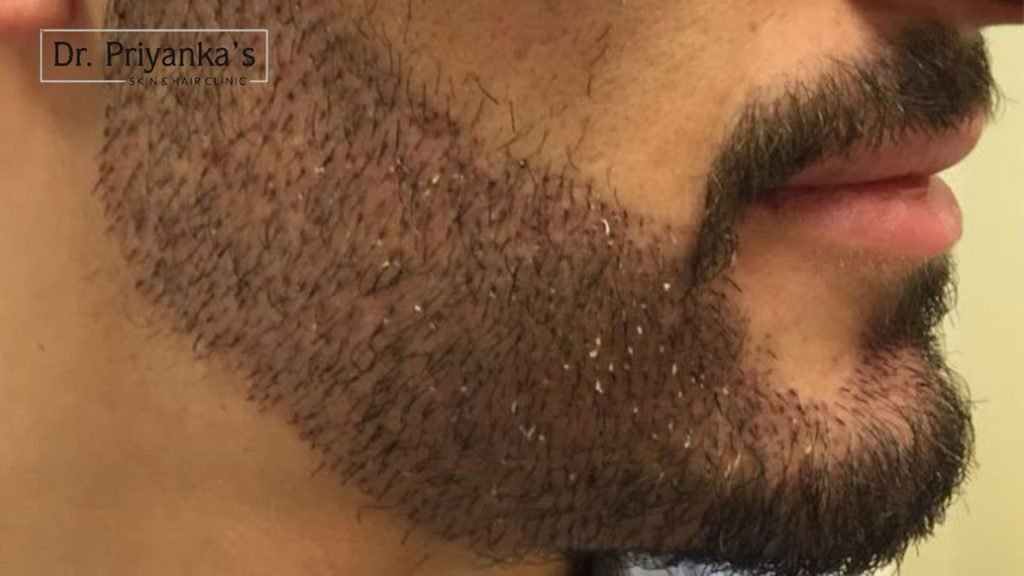
What Is a Beard Transplant?
A beard transplant is a hair restoration procedure in which doctors move healthy hair follicles from one part of the body to areas of the face that have inadequate hair growth.
The procedure can improve beard density and create a more uniform appearance.
Doctors commonly use hair follicles from the permanent donor area at the back or sides of the scalp. They extract individual follicular units and implant them into carefully selected areas of the beard.
A beard transplant can help men who have:
- Naturally thin or sparse beards
- Patchy beard growth
- Empty areas on the cheeks
- Incomplete moustache growth
- Poor beard density on the chin
- Gaps between the moustache and beard
- Beard scars following injuries or burns
- Hair loss after facial surgery
The objective is to create facial hair that follows the natural pattern of beard growth and suits the patient’s facial structure.
Who Is a Good Candidate for Beard Transplant Surgery?
Not every man with an uneven beard needs surgery. The doctor should first identify the reason for inadequate facial hair growth.
A beard transplant may be suitable for men who:
- Have naturally low beard density.
- Have genetically determined gaps in their beard.
- Have a sparse moustache or chin beard.
- Want to improve beard coverage on their cheeks.
- Have stable hair loss caused by scars or injuries.
- Have sufficient healthy donor hair.
- Have realistic expectations about density and appearance.
- Are medically suitable for a surgical procedure.
The doctor also evaluates the patient’s age, facial hair pattern, donor hair availability and long-term expectations.
Beard Transplant for Patchy Beard Growth
Patchy beard growth is one of the most common reasons men consider beard transplantation.
Some men develop thick hair on the chin and moustache but have very little hair on the cheeks. Others have isolated empty areas that make the beard appear uneven.
A transplant can fill selected areas with healthy follicles.
However, sudden beard patches require a different approach. Conditions such as alopecia areata, fungal infection and inflammatory or scarring disorders can cause facial hair loss. The underlying condition should be diagnosed and managed before considering transplantation.
Causes of Sparse Beard Growth
Several factors can contribute to inadequate beard density.
1. Genetics
Genetics plays a major role in determining beard thickness, distribution, colour and growth pattern.
Some men naturally develop dense facial hair, while others have a thinner beard despite otherwise normal health.
2. Hormonal Factors
Androgens, particularly testosterone and its metabolite dihydrotestosterone (DHT), influence facial hair development.
However, sparse beard growth does not automatically indicate low testosterone. Many men with normal hormone levels naturally have less facial hair because of genetic differences in follicular sensitivity.
Hormonal testing is generally considered when other symptoms suggest an underlying endocrine problem.
3. Alopecia Areata
Alopecia areata is an autoimmune condition that can affect the beard and produce smooth, round or irregular patches of hair loss.
It requires medical treatment rather than immediate hair transplantation.
Transplantation into an area affected by active alopecia areata may produce poor results because the disease can affect the transplanted follicles as well.
4. Facial Injuries and Burns
Accidents, burns and injuries can permanently damage hair follicles.
Once the skin has healed and the underlying condition has stabilised, selected scarred areas may be considered for hair transplantation.
5. Previous Surgery or Scarring
Facial surgery, trauma or certain skin conditions can leave areas without functional hair follicles.
A transplant may improve coverage in appropriately selected patients.
6. Previous Infection or Inflammation
Some infections and inflammatory skin diseases can damage hair follicles and cause permanent hair loss.
The doctor must determine whether the condition is inactive before planning surgery.
Beard Transplant Techniques
The most commonly discussed techniques involve harvesting individual follicular units or removing a strip of hair-bearing scalp tissue.
1. FUE Beard Transplant
FUE is widely used for beard transplantation.
In this technique, the surgeon extracts individual follicular units from the donor area using a small punch instrument.
The extracted grafts are then prepared and implanted into the beard.
Advantages include:
- No long linear donor scar
- Individual follicle extraction
- Small extraction marks
- Flexible donor-site selection
- Suitable for facial hair restoration
- Ability to place grafts according to the desired beard design
The donor area usually heals with small, scattered extraction marks. However, these marks can remain visible, particularly after very short haircuts or excessive extraction.
FUE is a surgical procedure and requires appropriate medical training, sterile conditions and careful donor management.
2. FUT Beard Transplant
FUT involves removing a narrow strip of hair-bearing scalp from the donor region. A surgical team then separates the strip into individual follicular units under magnification.
These grafts can be implanted into the beard.
FUT leaves a linear scar in the donor area and may be considered in selected situations when scalp hair is used as the donor source.
The choice between FUE and FUT depends on donor characteristics, surgical planning, the number of grafts required and the surgeon’s assessment.
When beard hair itself is used as the donor source, FUE is the appropriate harvesting method.
Which Areas Can Be Treated With Beard Transplant?
A beard transplant can address several facial areas.
1. Cheek Beard Transplant
Some men have dense hair on the chin and jawline but sparse growth on the cheeks.
Transplantation can increase coverage in selected cheek areas.
The surgeon must carefully design the upper beard boundary to avoid an artificial or straight-looking hairline.
2. Moustache Transplant
A moustache transplant can improve density in men with naturally thin moustaches or stable areas of missing hair.
The surgeon places follicles according to the natural direction of moustache growth.
3. Chin Beard Transplant
The chin is an important part of the beard’s overall appearance.
A transplant can improve density in the central or lateral chin areas when sufficient donor hair is available.
4. Goatee Transplant
A goatee transplant can improve hair coverage around the chin and lower mouth region.
It may also help create better continuity between the moustache and chin beard.
5. Jawline Beard Transplant
A jawline transplant can improve beard coverage along the lower facial border.
The surgeon must consider facial shape, existing hair and the direction of natural growth.
6. Sideburn Transplant
A sideburn transplant can improve the transition between scalp hair and facial hair.
Correct angulation is particularly important in this area.
How Is Beard Transplant Surgery Performed?
A beard transplant usually involves several stages.
Step 1: Consultation and Facial Assessment
The doctor examines the face and evaluates the patient’s beard growth pattern.
The assessment includes:
- Existing beard density
- Areas requiring additional coverage
- Skin condition
- Donor hair availability
- Hair thickness and texture
- Facial proportions
- Previous hair restoration procedures
- Medical history
- Patient expectations
The doctor also determines whether the beard gaps are stable or result from an active medical condition.
Step 2: Beard Design
The surgeon plans the desired beard shape according to facial anatomy and patient preference.
The design may include:
- Upper cheek beard line
- Moustache outline
- Chin density
- Jawline coverage
- Sideburn connection
- Areas requiring additional fullness
A natural beard should not look artificially straight or excessively dense.
Step 3: Donor Area Selection
The back and sides of the scalp commonly provide suitable donor follicles.
The surgeon assesses hair density, thickness, texture and available follicular units.
The donor area must be managed carefully because extracted follicles cannot regenerate.
The surgeon should also consider the patient’s future scalp hair restoration needs before allocating a large number of grafts to the beard.
Step 4: Local Anaesthesia
The surgeon administers local anaesthesia to the donor and recipient areas.
This helps minimise discomfort during follicle extraction and implantation.
Step 5: Follicle Extraction
The surgeon extracts individual follicular units using the selected technique.
The team handles the grafts carefully to protect the follicles and maintain their viability.
Step 6: Graft Preparation
The extracted follicles are examined and prepared for implantation.
Single-hair grafts are particularly useful along the upper beard boundary and in areas requiring a soft, natural appearance.
Other follicular units may be used in selected areas depending on the desired density and design.
Step 7: Graft Implantation
The surgeon creates recipient sites and places the follicles into the beard area.
The angle and direction of implantation are especially important.
Beard hair generally emerges at a shallow angle and changes direction across different facial regions. Incorrect placement can create an unnatural appearance.
Step 8: Postoperative Instructions
After implantation, the patient receives instructions regarding cleansing, medication, sleeping position, activity and protection of the transplanted area.
Following these instructions helps protect the grafts during early healing.
How Many Grafts Are Required for a Beard Transplant?
The number of grafts depends on the area requiring treatment and the desired density.
A small patch may require a few hundred grafts, while a larger beard restoration procedure may require considerably more.
The surgeon considers:
- Size of the recipient area
- Existing beard density
- Desired fullness
- Hair thickness
- Donor hair availability
- Facial hair distribution
- Number of previous procedures
The graft requirement should be determined after examining the patient rather than relying on a fixed package.
The International Society of Hair Restoration Surgery describes a broad range of graft requirements for beard transplantation, from a few hundred to more than 2,000 in selected cases.
Does Beard Transplant Look Natural?
Yes, a beard transplant can produce natural-looking results when the surgeon plans the design and implants the follicles correctly.
However, the quality of the result depends on several factors.
Correct Beard Design
The beard line should complement the patient’s facial shape.
An excessively straight or sharply defined upper beard boundary can look artificial.
Appropriate Hair Selection
The surgeon should select donor follicles that match the desired facial hair appearance as closely as possible.
Scalp hair can differ from beard hair in thickness, texture, curl and growth characteristics.
Correct Implantation Angle
The surgeon must follow the natural direction of hair growth.
Incorrect angulation can result in hair that projects outward rather than lying close to the skin.
Suitable Density
Overly dense implantation is not always appropriate.
The surgeon should balance graft numbers, existing hair and donor availability.
Beard Transplant Results: When Will You See Growth?
Beard transplantation does not produce an immediate permanent beard.
The transplanted follicles pass through a normal healing and growth cycle.
First Week
Patients may notice:
- Mild redness
- Swelling
- Small crusts
- Tenderness
- Temporary sensitivity
Small scabs around the implanted follicles are expected during early healing.
First Month
The transplanted hair shafts commonly shed during the early postoperative period.
This is called shock shedding and does not necessarily mean the follicles have been lost.
Three to Four Months
New hair growth usually begins to become noticeable in many patients.
The growth pattern may initially look uneven.
Six Months
The beard generally shows more visible improvement as additional follicles produce hair.
Nine to Twelve Months
The cosmetic result becomes more apparent as the transplanted hairs mature.
The International Society of Hair Restoration Surgery describes visible regrowth after approximately three to four months, with the overall result developing over roughly 10–14 months. Individual timelines vary.
Is Beard Transplant Permanent?
Transplanted follicles usually retain many of the characteristics of their donor area.
When healthy follicles from a suitable donor region survive and establish a blood supply, they can produce long-term hair growth.
However, no surgeon can guarantee that every implanted graft will grow.
The final density depends on:
- Donor follicle quality
- Graft survival
- Surgical technique
- Skin condition
- Healing
- Individual biological response
Some patients may require a second session to achieve their desired density.
Recovery After Beard Transplant
Recovery varies between individuals and depends on the number of grafts and the surgical technique.
Most patients can return to light routine activities relatively quickly, but they should follow their surgeon’s instructions carefully.
General recovery considerations include:
First 48–72 hours
- Avoid touching or rubbing the implanted area.
- Follow the prescribed cleansing routine.
- Avoid pressure on the transplanted follicles.
- Sleep in the recommended position.
- Take prescribed medicines as directed.
First week
- Allow crusts to heal naturally.
- Avoid picking or scratching the grafts.
- Avoid strenuous exercise if advised.
- Protect the face from accidental trauma.
Following weeks
- Resume normal activities according to the surgeon’s advice.
- Follow instructions about shaving.
- Avoid excessive sun exposure during early healing.
The exact timing for washing, shaving and exercise depends on the procedure and the surgeon’s postoperative protocol.
Side Effects and Possible Complications
Beard transplantation is a surgical procedure. Although many patients recover without significant problems, complications can occur.
Possible side effects include:
- Temporary redness
- Swelling
- Bruising
- Tenderness
- Temporary numbness
- Crusting
- Folliculitis
- Ingrown hairs
- Infection
- Pigmentation changes
- Scarring
- Poor graft growth
- Uneven density
- Incorrect hair direction
- Unnatural beard design
Folliculitis
Some patients develop small inflammatory bumps around transplanted follicles.
These may result from inflammation, ingrown hairs or infection.
Persistent or painful pustules should be examined by a doctor.
Pigmentation Changes
Post-inflammatory hyperpigmentation can occur, particularly in people with darker skin types.
The surgeon should consider skin type and pigmentation tendency during treatment planning.
Unnatural Hair Direction
One of the most important technical challenges in beard transplantation is achieving the correct angle and direction.
Improperly placed grafts may grow in an unnatural direction and sometimes require corrective treatment.
Donor Area Scarring
FUE leaves small scattered extraction marks. Excessive harvesting can produce visible thinning or irregularity in the donor area.
The surgeon should avoid overharvesting and preserve donor reserves for future needs.
Beard Transplant vs Beard Growth Medicines
Some men try beard growth products before considering surgery.
Medical treatment may be useful in selected patients, depending on the underlying cause of sparse beard growth.
However, medicines cannot reliably create new follicles in areas where follicles are absent or permanently destroyed.
A dermatologist may assess whether the patient has:
- Genetic low beard density
- Alopecia areata
- Hormonal abnormalities
- Nutritional deficiencies
- Scarring hair loss
- Inflammatory skin disease
The correct treatment depends on the diagnosis.
A beard transplant is generally considered when the patient has stable areas of inadequate hair growth and sufficient donor follicles.
Beard Transplant vs Beard Micropigmentation
Micropigmentation and beard transplantation are different procedures.
Beard transplant
- Uses living hair follicles.
- Produces actual hair growth.
- Allows patients to trim or style the beard.
- Requires surgery and recovery.
- Depends on graft survival.
Beard micropigmentation
- Uses pigment deposited into the skin.
- Creates the appearance of beard shadow or density.
- Does not produce actual hair.
- Requires maintenance and possible touch-up sessions.
- Cannot replace the texture or length of real beard hair.
The appropriate option depends on the patient’s expectations and existing beard pattern.
Who Should Avoid or Delay Beard Transplant Surgery?
A beard transplant may not be appropriate in every situation.
Surgery should generally be delayed or avoided when there is:
- Active alopecia areata
- Active skin infection
- Uncontrolled inflammatory skin disease
- Unstable scarring hair loss
- Insufficient donor hair
- Uncontrolled medical conditions that increase surgical risk
- Unrealistic expectations
- Inadequate understanding of the limitations
A doctor should assess the patient’s overall health and the stability of any underlying skin condition before recommending surgery.
Beard Transplant Cost in Jaipur
The cost of beard transplant in Jaipur varies depending on the surgical requirements and the number of grafts needed.
Factors affecting the cost include:
- Number of grafts required.
- Size of the area being treated.
- FUE or other harvesting technique.
- Donor hair availability.
- Hair characteristics.
- Surgical complexity.
- Experience and qualifications of the surgeon.
- Anaesthesia and facility requirements.
- Postoperative care and follow-up.
A small patch correction may require fewer grafts than full beard reconstruction.
For this reason, clinics should provide an individual estimate after assessing the face and donor area.
During consultation, ask for a clear breakdown of the graft estimate, procedure, surgeon’s role, aftercare and follow-up charges.
How to Choose the Best Beard Transplant Surgeon in Jaipur
Choosing the right surgeon is one of the most important decisions when considering beard transplantation.
The procedure requires a combination of surgical skill, facial anatomy knowledge and an understanding of natural hair direction.
Before choosing a clinic, consider the following:
1. Check the Surgeon’s Qualifications
Confirm that the surgeon performing the procedure has appropriate recognised medical and surgical qualifications and specific hair restoration experience.
2. Review Genuine Before-and-After Results
Ask to see photographs of previous beard transplant patients.
Look for:
- Natural cheek lines
- Appropriate moustache density
- Correct hair direction
- Consistent growth
- Minimal visible donor scarring
3. Understand Who Performs Each Part of the Procedure
Ask who designs the beard, administers anaesthesia, extracts grafts and implants the follicles.
The responsible surgeon’s involvement should be clearly explained.
4. Ask About Donor Hair Management
Donor follicles are limited.
A good surgical plan should avoid unnecessary extraction and consider the patient’s future scalp hair restoration needs.
5. Discuss Risks and Limitations
A responsible surgeon should explain possible complications, expected growth, realistic density and the possibility of additional sessions.
6. Check Follow-Up Arrangements
Postoperative review is important for identifying complications and monitoring graft growth.
Why Consider Collagen Clinics for Beard Transplant Consultation in Jaipur?
At Collagen Clinics, Jaipur, patients can discuss facial hair restoration concerns and receive an assessment of their skin, beard pattern and treatment requirements.
The evaluation may include:
- Existing beard density
- Areas of inadequate growth
- Possible medical causes of patchy beard loss
- Facial skin condition
- Donor hair availability
- Expected graft requirement
- Suitable treatment options
- Recovery and aftercare expectations
For patients considering surgery, the procedure and its risks should be discussed with the appropriately qualified hair restoration surgeon.
The aim is to help patients make an informed decision and pursue a natural-looking result that complements their facial structure.
Frequently Asked Questions
1. What is the best age for a beard transplant?
There is no fixed age for every patient. Doctors generally prefer to assess beard development and the stability of facial hair patterns before recommending surgery. The patient’s age, donor hair availability and expectations all matter.
2. Is beard transplant painful?
The procedure is usually performed under local anaesthesia, which reduces pain during surgery. Patients may experience temporary discomfort, swelling or tenderness afterward.
3. How many grafts are required for a full beard transplant?
The number depends on the size of the area, existing hair density and desired coverage. Some patients need a few hundred grafts, while extensive reconstruction may require more than 2,000.
4. Does transplanted beard hair grow permanently?
Transplanted follicles can produce long-term hair growth when they survive and establish a blood supply. However, complete graft survival cannot be guaranteed.
5. When can I shave after a beard transplant?
The timing depends on the surgeon’s instructions and healing progress. Patients should avoid shaving or disturbing the implanted area until the surgeon confirms it is safe.
6. Will transplanted beard hair look natural?
Natural results depend on appropriate graft selection, facial design and correct implantation angles. A skilled surgeon places the follicles according to the natural growth direction of each facial region.
7. Can I get a beard transplant if I have alopecia areata?
Active alopecia areata is generally not suitable for immediate transplantation. The condition should first be diagnosed and medically controlled. Surgery may be considered only in carefully selected stable cases after specialist evaluation.
8. Can beard transplant cover burn scars?
It may improve hair coverage in selected stable scars. However, scar tissue can have reduced blood supply and may not support graft survival as reliably as normal skin. The surgeon must assess the scar before treatment.
9. How long does a beard transplant take?
The duration depends on the number of grafts, donor harvesting and implantation requirements. The clinic can provide an estimate after examining the patient.
10. Are the results visible immediately?
The implanted hair shafts are initially visible, but many shed during the early postoperative period. New growth generally begins after a few months, and the final result takes approximately 10–14 months to mature in many patients.
11. Can scalp hair be used for beard transplantation?
Yes. Scalp hair is commonly used as a donor source. The surgeon must consider differences in thickness, texture and growth characteristics when selecting and placing the grafts.
12. Can beard hair be used as donor hair?
Selected beard follicles, usually from beneath the jawline, can be used as donor hair for certain hair restoration procedures. FUE is used for harvesting beard donor follicles.
13. Does beard transplant leave scars?
FUE generally leaves small scattered extraction marks in the donor area. The recipient area can also develop temporary marks or, less commonly, visible scarring or pigmentation changes.
14. What is the cost of beard transplant in Jaipur?
The cost depends on the graft count, surgical technique, complexity and surgeon’s expertise. A personalised estimate requires consultation and donor-area assessment.
15. Is beard transplant better than beard growth oil?
Beard oils mainly condition the hair and skin. They do not reliably create new hair follicles. A transplant can add follicles to selected areas, but it is a surgical procedure with risks and limitations.
Conclusion
A beard transplant can help men who have naturally sparse facial hair, patchy beard growth or stable areas of hair loss caused by scars and injuries.
Modern FUE techniques allow surgeons to transfer individual follicles and create improved beard coverage. However, successful beard restoration requires much more than simply implanting grafts. Facial design, donor hair selection, graft survival and correct implantation angles all influence the final result.
If you are considering a beard transplant in Jaipur, begin with a proper medical and surgical assessment. The doctor should identify the cause of inadequate beard growth, evaluate donor hair availability and explain the likely results, recovery period, cost and potential complications.
At Collagen Clinics, Jaipur, patients can seek guidance on beard restoration options and discuss an appropriate treatment plan with the relevant medical specialist.
The goal should always be a natural-looking beard that suits your face, with careful attention to safety, donor hair preservation and realistic expectations.