
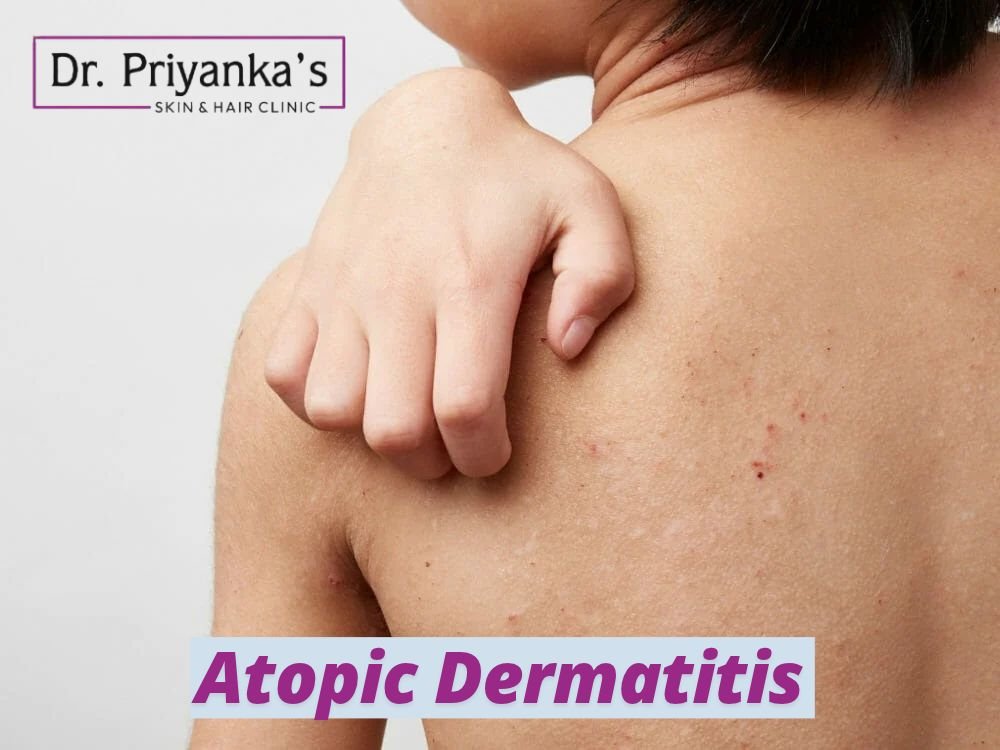
Atopic dermatitis, commonly called eczema, is a chronic inflammatory skin condition that causes itching, dryness, redness, scaling and recurrent skin rashes. It can affect babies, children and adults and often follows a pattern of flare-ups and periods of improvement.
The condition can significantly affect sleep, work, school and quality of life. However, appropriate treatment can control inflammation, reduce itching, repair the skin barrier and decrease the frequency of flare-ups.
Atopic dermatitis treatment in Jaipur may include moisturisers, topical corticosteroids, topical calcineurin inhibitors, non-steroidal topical medicines, phototherapy, biologic medicines and systemic treatments, depending on the severity and age of the patient.
At Collagen Clinics, Jaipur, Dr Priyanka Sharma evaluates the patient’s symptoms, skin findings, severity, age, treatment history and possible triggers before developing an individualised treatment plan.
What Is Atopic Dermatitis?
Atopic dermatitis is a chronic inflammatory skin disease associated with an impaired skin barrier and an overactive immune response.
People with atopic dermatitis often have dry and sensitive skin. Their skin barrier does not retain moisture effectively and may allow irritants and allergens to penetrate more easily.
This can trigger inflammation and itching.
Atopic dermatitis often follows a relapsing and remitting course. This means the skin may improve significantly for some time and then flare again.
It is not simply a problem of dry skin. It involves a combination of:
- Skin-barrier dysfunction
- Immune-system dysregulation
- Genetic susceptibility
- Environmental triggers
- Individual skin sensitivity
Symptoms of Atopic Dermatitis
The symptoms vary depending on age, severity and the affected body area.
Common symptoms include:
- Intense itching
- Dry skin
- Red or inflamed patches
- Scaling
- Rough skin
- Cracking
- Oozing during severe flares
- Thickened skin after repeated scratching
- Darkening or lightening after inflammation
- Sleep disturbance
Itching often becomes particularly troublesome at night.
In children, persistent itching can affect sleep, concentration and daily activities.
Where Does Atopic Dermatitis Occur?
The distribution can vary with age.
Babies
Infants commonly develop eczema on the:
- Cheeks
- Scalp
- Forehead
- Outer surfaces of the limbs
- Trunk
Children
Older children may develop eczema around:
- Elbows
- Knees
- Wrists
- Ankles
- Neck
- Hands
Adults
Adults can develop eczema on:
- Hands
- Face
- Eyelids
- Neck
- Flexures
- Arms
- Legs
- Trunk
Some adults develop predominantly hand eczema or eyelid eczema.
What Causes Atopic Dermatitis?
Atopic dermatitis does not have one single cause.
Several factors can contribute to its development.
1. Genetic Predisposition
Some people inherit a tendency toward impaired skin-barrier function and allergic or inflammatory skin conditions.
A family history of eczema, asthma or allergic rhinitis can occur in some patients.
2. Impaired Skin Barrier
Healthy skin prevents excessive water loss and protects the body from irritants and microorganisms.
In atopic dermatitis, the skin barrier becomes less effective. This can increase dryness and sensitivity and allow irritants to penetrate the skin more easily.
3. Immune Dysfunction
The immune system plays an important role in the inflammation associated with atopic dermatitis.
4. Environmental Triggers
Several environmental factors can worsen eczema, including:
- Heat
- Sweating
- Dry weather
- Excessive bathing
- Harsh soaps
- Fragrances
- Detergents
- Wool or rough fabrics
- Stress
- Certain skincare products
However, triggers differ between individuals.
Is Atopic Dermatitis Contagious?
No. Atopic dermatitis is not contagious.
You cannot catch eczema by touching, hugging or sharing personal space with someone who has atopic dermatitis.
This is important because chronic skin rashes are sometimes incorrectly assumed to be infections.
How Is Atopic Dermatitis Diagnosed?
A dermatologist usually diagnoses atopic dermatitis clinically.
The doctor may evaluate:
- Appearance of the rash
- Distribution of lesions
- Duration of symptoms
- Severity of itching
- History of recurrent flares
- Personal or family history of allergic conditions
- Response to previous treatment
Routine blood tests are not necessary for every patient.
If the diagnosis remains uncertain or treatment does not produce the expected improvement, the dermatologist may consider additional investigations such as patch testing, skin scraping or biopsy depending on the clinical situation. Current AAD guidance specifically supports diagnostic reassessment in adults with treatment-resistant presumed atopic dermatitis.
Atopic Dermatitis Treatment in Jaipur
The treatment depends on the severity of the disease.
Mild eczema may respond well to regular moisturisation and appropriate topical treatment.
Moderate or severe eczema may require stronger anti-inflammatory treatment, phototherapy or systemic medicines.
1. Moisturisers and Emollients
Moisturisation forms the foundation of atopic dermatitis management.
Regular moisturiser use helps:
- Improve the skin barrier
- Reduce dryness
- Reduce itching
- Prevent cracks
- Reduce flare frequency
- Reduce the need for anti-inflammatory medicines in some patients
The 2026 Indian guidelines strongly recommend regular moisturiser use as a key part of atopic dermatitis management. They suggest applying moisturisers at least twice daily and more frequently during acute flares.
Choose fragrance-free moisturisers designed for sensitive skin.
2. Topical Corticosteroids
Topical corticosteroids remain an important treatment for eczema flares.
They reduce inflammation, redness and itching.
The dermatologist selects the potency according to:
- Patient’s age
- Body site
- Severity
- Thickness of the lesion
- Duration of treatment
Patients should avoid prolonged unsupervised use of potent steroids, particularly on the face, eyelids, genital area and skin folds.
Used correctly under medical supervision, topical corticosteroids can be an effective and safe component of eczema treatment. Current Indian guidelines strongly recommend their appropriate use in atopic dermatitis.
3. Tacrolimus and Pimecrolimus
Topical calcineurin inhibitors such as tacrolimus and pimecrolimus provide non-steroid anti-inflammatory treatment.
They can be particularly useful for sensitive areas such as:
- Face
- Eyelids
- Neck
- Skin folds
They can also play a role in maintenance treatment to reduce recurrent flares.
The 2026 Indian guidelines recommend topical calcineurin inhibitors for atopic dermatitis and support proactive intermittent treatment for recurrent areas.
4. Newer Non-Steroidal Topical Treatments
Newer topical treatments have expanded the options available for patients with eczema.
Depending on the patient’s age, severity and availability, dermatologists may consider medicines such as:
- Crisaborole
- Roflumilast
- Tapinarof
- Ruxolitinib
These medications have different mechanisms and eligibility criteria.
The AAD’s recent guideline updates include several of these newer topical therapies, reflecting the rapidly expanding treatment options for atopic dermatitis.
5. Wet-Wrap Therapy
Wet-wrap therapy can help selected patients with moderate to severe eczema, particularly during significant flares.
It involves applying prescribed topical treatment or moisturiser followed by appropriate wet and dry layers.
This approach can:
- Increase skin hydration
- Reduce itching
- Improve penetration of topical treatment
- Calm acute inflammation
A dermatologist should guide wet-wrap treatment because infection must be considered before using this approach.
6. Phototherapy
Phototherapy may help selected patients with moderate to severe atopic dermatitis who do not achieve adequate control with topical treatment.
Narrowband UVB is one of the commonly considered phototherapy options.
Phototherapy requires a structured treatment schedule and medical supervision.
7. Biologic Treatment
Biologic medicines have transformed the treatment of moderate to severe atopic dermatitis.
Dupilumab is an important biologic treatment that targets specific inflammatory pathways involved in atopic dermatitis.
Other biologic therapies may also be considered depending on the patient’s age, severity, previous treatment, availability and regulatory status.
Current international guidelines strongly recommend several biologic therapies for appropriate patients with moderate to severe disease.
8. JAK Inhibitors
JAK inhibitors represent another important development in the treatment of moderate to severe atopic dermatitis.
Examples include:
- Abrocitinib
- Upadacitinib
- Baricitinib
These medicines can produce significant improvement in inflammation and itching in appropriately selected patients.
However, they require careful patient selection and medical monitoring because systemic JAK inhibitors can have important safety considerations.
The 2026 Indian guidelines provide specific recommendations regarding systemic JAK inhibitors and their role in Indian clinical practice.
Treatment of Severe Atopic Dermatitis
Patients with severe eczema may experience:
- Extensive body involvement
- Severe itching
- Sleep disturbance
- Frequent flares
- Significant impact on quality of life
- Recurrent infections
- Failure of appropriate topical therapy
These patients may require a systemic treatment plan.
Depending on the individual case, options can include:
- Phototherapy
- Biologic therapy
- Oral JAK inhibitors
- Conventional immunosuppressive medicines
The choice depends on age, severity, comorbidities, previous treatments, pregnancy considerations, infection risk and other clinical factors.
Atopic Dermatitis in Children
Atopic dermatitis commonly begins during childhood.
Treatment requires special attention because children’s skin differs from adult skin and because medication selection depends on age.
Treatment may include:
- Regular moisturisation
- Appropriate topical corticosteroids
- Topical calcineurin inhibitors
- Other approved non-steroidal topical treatments
- Wet dressings in selected cases
- Phototherapy
- Systemic or biologic treatment for selected moderate-to-severe disease
Updated 2026 pediatric AAD guidelines include strong recommendations for several topical therapies and systemic/biologic treatments in appropriately selected children and adolescents.
Parents should avoid experimenting with multiple creams without medical guidance, particularly combination creams containing steroids, antifungals and antibiotics.
Atopic Dermatitis on the Face and Eyelids
Facial eczema requires particularly careful treatment.
The skin around the eyes is thin and more susceptible to adverse effects from inappropriate or prolonged topical steroid use.
Depending on the clinical situation, dermatologists may use:
- Appropriate low-potency topical corticosteroids for limited periods
- Tacrolimus
- Pimecrolimus
- Other suitable non-steroidal treatments
- Regular moisturisation
Persistent eyelid eczema may sometimes indicate allergic contact dermatitis rather than atopic dermatitis, so diagnostic reassessment may become important.
Atopic Dermatitis on the Hands
Hand eczema can significantly affect daily activities and work.
Patients may develop:
- Dryness
- Cracks
- Scaling
- Redness
- Pain
- Itching
- Thickened skin
Frequent exposure to water, detergents, chemicals and irritants can worsen hand eczema.
Treatment combines medical therapy with protection from irritants and appropriate moisturisation.
Can Food Cause Atopic Dermatitis?
Food allergy and atopic dermatitis can coexist, particularly in children, but food is not the cause of eczema in every patient.
Unnecessary elimination diets can create nutritional problems and may not improve the eczema.
Food allergy evaluation should be considered when the clinical history suggests a genuine food-related reaction.
Patients should not eliminate multiple foods without appropriate medical advice.
Can Stress Trigger Eczema?
Stress does not cause every case of atopic dermatitis, but psychological stress can worsen symptoms in some patients.
Stress may contribute to:
- Increased itching
- Scratching
- Sleep problems
- Flare-ups
Managing stress can therefore form part of an overall eczema-management plan.
Atopic Dermatitis and Infection
Patients with eczema have an increased risk of developing secondary skin infections.
Warning signs include:
- Sudden worsening
- Increasing pain
- Pus
- Weeping or crusting
- Fever
- Rapidly spreading redness
Infection requires appropriate medical assessment.
Routine antibiotic treatment without evidence of infection is not recommended. The 2026 Indian guidelines specifically discourage routine topical or oral antibiotics and recommend antibiotics when there is clear evidence of secondary infection.
Why You Should Avoid Self-Medicating With Steroid Creams
One of the common problems in eczema management is unsupervised use of topical corticosteroids.
Some patients repeatedly use potent steroid-containing creams because they provide rapid relief.
Long-term inappropriate use can cause problems such as:
- Skin thinning
- Visible blood vessels
- Steroid acne
- Changes in pigmentation
- Perioral dermatitis
- Rebound or worsening after inappropriate discontinuation
- Masking of fungal infections
This does not mean that steroid creams are unsafe.
The problem is inappropriate potency, location, duration and unsupervised use.
A dermatologist can select the appropriate medicine and explain how and when to use it.
How to Prevent Atopic Dermatitis Flare-Ups
Treatment does not end when the rash improves.
Long-term maintenance can reduce recurrent flares.
Use Moisturiser Regularly
Apply a suitable moisturiser at least twice daily or as recommended by your dermatologist.
Take Short, Lukewarm Baths
Avoid very hot water because it can worsen dryness and irritation.
Use Gentle Cleansers
Choose fragrance-free, gentle cleansing products.
Avoid Known Irritants
Depending on your triggers, you may need to minimise exposure to:
- Perfumes
- Harsh detergents
- Wool
- Strong soaps
- Certain cosmetics
- Excessive heat
- Sweat
Keep Nails Short
Keeping nails short can reduce skin damage from scratching.
Follow Your Maintenance Plan
Some patients benefit from intermittent anti-inflammatory treatment on previously affected areas even when the skin appears clear.
Is There a Permanent Cure for Atopic Dermatitis?
Atopic dermatitis is a chronic condition, so there is no guaranteed permanent cure.
However, excellent long-term control is possible.
The goal of treatment is to:
- Clear active inflammation
- Control itching
- Repair the skin barrier
- Prevent flares
- Reduce scratching
- Prevent complications
- Improve quality of life
Some children experience significant improvement as they grow older, while others continue to experience eczema into adulthood.
Atopic Dermatitis Treatment Cost in Jaipur
The cost of atopic dermatitis treatment in Jaipur varies significantly depending on the severity and treatment required.
Factors include:
- Consultation
- Severity of eczema
- Medicines prescribed
- Number of follow-up visits
- Phototherapy requirements
- Laboratory monitoring when necessary
- Biologic or systemic treatment
- Duration of treatment
Mild eczema generally requires a much simpler treatment plan than severe disease requiring systemic therapy.
Therefore, there is no single fixed price for atopic dermatitis treatment.
Why Choose Collagen Clinics for Atopic Dermatitis Treatment in Jaipur?
At Collagen Clinics, Jaipur, the approach focuses on identifying the type and severity of eczema before selecting treatment.
Dr Priyanka Sharma evaluates:
- Pattern of the rash
- Severity
- Itching
- Skin-barrier condition
- Previous treatment
- Possible triggers
- Infection
- Patient’s age
- Associated allergic conditions
- Response to previous medicines
The treatment plan can then be adjusted according to the patient’s response.
For patients with persistent or difficult-to-control eczema, diagnostic reassessment and advanced treatment options may be considered.
Frequently Asked Questions
What is the best treatment for atopic dermatitis?
There is no single best treatment for everyone. Moisturisers form the foundation of management, while topical anti-inflammatory medicines treat active disease. Moderate-to-severe cases may require phototherapy, biologics or systemic medicines.
Can atopic dermatitis be cured permanently?
Atopic dermatitis is a chronic inflammatory condition rather than a disease with a guaranteed permanent cure. However, appropriate treatment can provide long-term control and significantly reduce flare-ups.
Is eczema contagious?
No. Atopic dermatitis is not contagious and cannot spread from one person to another through physical contact.
Can I use steroid cream for eczema?
Topical corticosteroids are an important treatment for eczema when doctors prescribe and use them appropriately. Avoid prolonged self-medication, particularly with potent steroids.
Can atopic dermatitis affect children?
Yes. Atopic dermatitis commonly begins during infancy or childhood. Treatment should match the child’s age, severity and affected body site.
Can atopic dermatitis affect the face?
Yes. Facial and eyelid eczema can occur. Because facial skin is sensitive, treatment should be selected carefully by a dermatologist.
Is atopic dermatitis caused by poor hygiene?
No. Atopic dermatitis does not result from poor hygiene. Excessive washing and harsh soaps can actually worsen the skin barrier.
Can food cause eczema?
Certain food allergies can coexist with eczema, particularly in children, but food does not cause every case. Unnecessary food restriction should be avoided.
When should I see a dermatologist?
Consult a dermatologist if eczema is persistent, recurrent, severe, affecting sleep, becoming infected, or failing to improve with appropriate skincare.
How much does atopic dermatitis treatment cost in Jaipur?
Treatment cost depends on disease severity and the type of treatment required. Mild eczema and severe eczema requiring systemic treatment can have very different costs.
Conclusion
Atopic dermatitis can be frustrating because it often improves and then returns. However, modern dermatology provides many effective options for controlling the disease.
Treatment may include moisturisers, topical corticosteroids, tacrolimus, pimecrolimus, newer non-steroidal topical medicines, phototherapy, biologic therapies and systemic treatments.
The right treatment depends on the patient’s age, severity, affected areas, previous treatment and overall health.
If you are looking for atopic dermatitis treatment in Jaipur, a dermatologist can help identify the severity of your eczema and develop an individualised long-term management plan.
At Collagen Clinics, Jaipur, Dr Priyanka Sharma provides personalised dermatological care with an emphasis on accurate diagnosis, appropriate treatment selection and long-term control of chronic skin conditions.