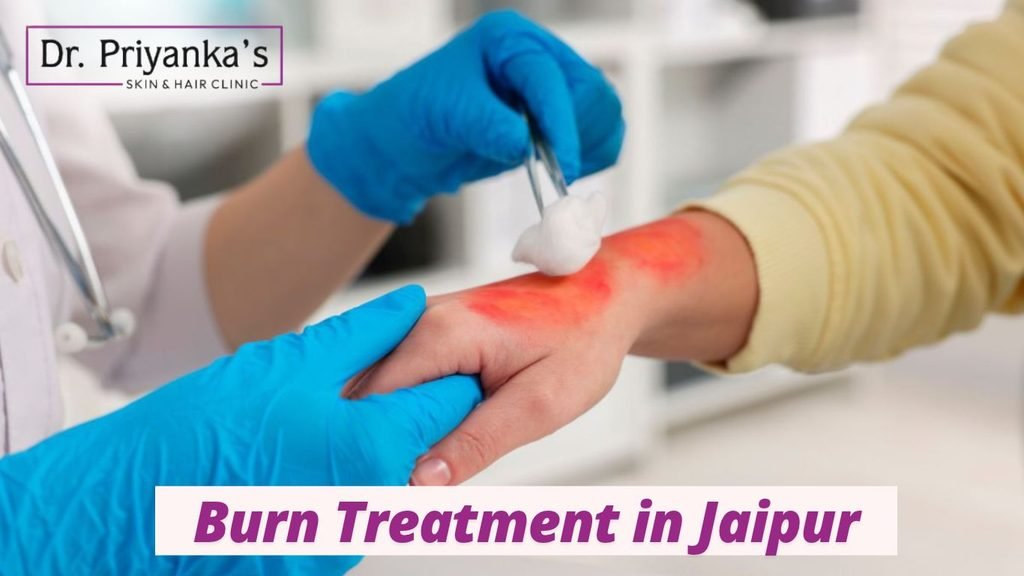
Burn injuries can affect the skin in different ways, ranging from minor redness and superficial burns to deeper injuries that cause blisters, tissue damage and permanent scarring. Apart from the initial injury, burns can also lead to long-term problems such as pigmentation changes, raised scars, itching, skin tightening and restricted movement.
The appropriate treatment depends on the depth of the burn, the affected body area, the extent of tissue damage and the stage of healing.
If you are searching for burn treatment in Jaipur, it is important to consult the appropriate medical specialist. Acute or extensive burns require urgent hospital-based assessment and treatment, while healed burn scars, post-burn pigmentation and certain skin changes may benefit from dermatological and plastic surgical management.
Dr Priyanka Sharma, Dermatologist in Jaipur, provides dermatological evaluation and guidance for skin-related concerns following burn injuries, including pigmentation changes, scar-related skin problems and post-burn skin texture concerns.
This article explains the different types of burns, their symptoms, immediate first aid, medical treatment options and available approaches for managing burn scars.
What Is a Burn Injury?
A burn is an injury to the skin or underlying tissues caused by exposure to heat, chemicals, electricity, radiation or friction.
The skin acts as a protective barrier against infection, fluid loss and environmental damage. When a burn damages this barrier, the affected area becomes vulnerable to inflammation, infection and other complications.
Burn injuries may affect:
- The outer layer of skin (epidermis).
- The deeper layer of skin (dermis).
- Subcutaneous fat.
- Muscles, nerves and other deeper structures in severe cases.
The severity of a burn depends on its depth, size, location and the mechanism of injury.
Some superficial burns heal without permanent marks, while deeper burns may require specialised wound care, surgery, skin grafting and long-term scar management.
Common Causes of Burns
Burn injuries can occur in everyday situations, workplaces and accidents.
Some common causes include:
1. Thermal Burns
Thermal burns are caused by exposure to heat.
Examples include:
- Hot water or boiling liquids.
- Hot cooking oil.
- Flames and fire accidents.
- Hot utensils and surfaces.
- Steam exposure.
Scald burns from hot liquids are particularly common in children and domestic environments.
2. Chemical Burns
Chemical burns occur when the skin comes into contact with corrosive substances.
Common causes include:
- Strong acids.
- Alkalis.
- Industrial cleaning agents.
- Certain chemical products.
- Occupational chemical exposure.
Chemical burns can continue damaging tissue until the chemical is removed or neutralised appropriately through safe medical management.
3. Electrical Burns
Electrical burns occur when electric current passes through the body.
They may cause significant internal tissue damage even when the external skin injury appears relatively small.
Electrical injuries require urgent medical assessment.
4. Radiation Burns
Radiation burns may develop following excessive exposure to ultraviolet radiation or certain medical radiation treatments.
Severe sunburn is a common example of ultraviolet-related skin injury.
5. Friction Burns
Friction burns develop when repeated rubbing against a rough surface generates heat and damages the skin.
They can occur during road accidents, falls and sports injuries.
Classification of Burns According to Depth
Burns are commonly classified according to how deeply the skin and underlying tissues are damaged.
Understanding the depth helps determine the appropriate treatment and the possibility of scarring.
1. First-Degree Burns (Superficial Burns)
First-degree burns affect only the epidermis, the outermost layer of the skin.
Common features include:
- Redness.
- Mild swelling.
- Pain and tenderness.
- Dry skin.
- Absence of blisters.
A mild sunburn is a common example.
These burns generally heal within several days and usually do not cause permanent scarring.
2. Second-Degree Burns (Partial-Thickness Burns)
Second-degree burns affect the epidermis and part of the dermis.
They may be superficial partial-thickness or deep partial-thickness injuries.
Symptoms may include:
- Fluid-filled blisters.
- Red or pink skin.
- Significant pain.
- Swelling.
- Moist or weeping skin.
Superficial partial-thickness burns may heal within approximately two to three weeks, whereas deeper injuries can take longer and carry a greater risk of scarring.
Appropriate wound assessment is important because some deeper partial-thickness burns may require surgical treatment.
3. Third-Degree Burns (Full-Thickness Burns)
Third-degree burns destroy the full thickness of the skin and may extend into deeper tissues.
Common features include:
- White, brown, leathery or charred skin.
- Dry and firm wound surfaces.
- Significant tissue destruction.
- Reduced sensation in the centre of the injury due to nerve damage.
Contrary to common belief, severe burns may not always be extremely painful in the centre because sensory nerve endings can be destroyed.
These injuries require urgent specialist hospital management and may need surgical excision and skin grafting.
4. Fourth-Degree Burns
Fourth-degree burns extend beyond the skin into deeper structures such as fat, muscles, tendons or bones.
They are extremely severe injuries requiring specialised multidisciplinary treatment.
Symptoms of Burn Injuries
The symptoms depend on the type and depth of the burn.
Common symptoms include:
- Redness and inflammation.
- Pain and tenderness.
- Blister formation.
- Swelling.
- Peeling or damaged skin.
- Fluid discharge.
- White, brown or black discolouration.
- Reduced sensation in deeper burns.
- Delayed wound healing.
- Development of scars after healing.
Patients with severe burns may also experience fever, dehydration, weakness and signs of systemic illness.
Burns associated with smoke inhalation can cause coughing, breathing difficulty, hoarseness and other respiratory symptoms.
Immediate First Aid for Burns
Correct first aid can reduce further tissue damage and improve healing outcomes.
If a person sustains a thermal burn, follow these steps:
Step 1: Stop the Burning Process
Move away from the heat source and ensure that the environment is safe.
If clothing catches fire, stop, drop and roll to extinguish the flames.
Step 2: Cool the Burn
Place the affected area under cool running water for approximately 20 minutes, as soon as possible.
Avoid using ice or extremely cold water because these can cause additional tissue injury.
Keep the rest of the body warm, particularly in children and patients with larger burns.
Step 3: Remove Jewellery and Tight Clothing
Remove rings, watches, bracelets and other tight items before swelling develops.
Remove clothing that is not stuck to the burned skin.
Never forcibly remove material adhering to the wound.
Step 4: Cover the Burn
After cooling, cover the affected area loosely with a clean, non-adherent dressing or clean cloth.
Avoid applying pressure.
Step 5: Seek Appropriate Medical Attention
Medical evaluation is essential for deep burns, extensive burns, burns involving sensitive areas and injuries associated with other complications.
Important: Do not apply toothpaste, butter, oils, ghee, turmeric, ice or household remedies to fresh burns. Do not deliberately burst blisters.
For chemical burns, seek emergency medical guidance and irrigate the affected area with abundant running water when appropriate. Dry chemical powders should be brushed away safely before irrigation.
When Is a Burn Injury a Medical Emergency?
Not every burn can be managed through routine outpatient treatment.
Immediate hospital assessment is required in situations such as:
- Extensive burns involving large areas of the body.
- Deep or full-thickness burns.
- Burns involving the face, hands, feet or genital region.
- Electrical injuries.
- Significant chemical burns.
- Burns associated with breathing difficulty.
- Suspected smoke inhalation.
- Burns in very young children or medically vulnerable individuals.
- Burns associated with severe pain, dehydration or signs of shock.
Patients with these injuries should not wait for a routine dermatology appointment.
The initial priority is emergency stabilisation, assessment of burn depth and extent, fluid management where required, pain control, wound management and specialist referral.
Burn Treatment in Jaipur: Available Medical Treatment Options
Burn treatment is not the same for every patient. The choice of treatment depends on whether the injury is fresh, healing or already healed.
1. Wound Cleaning and Dressing
Appropriate wound cleaning and dressing are important in the management of partial-thickness burns.
Medical professionals assess the wound and select suitable dressings according to its depth, location, exudate and healing stage.
The objectives are to:
- Protect the injured skin.
- Maintain an appropriate wound environment.
- Reduce contamination.
- Support tissue healing.
- Minimise unnecessary trauma during dressing changes.
The choice of dressing should be made by the treating medical team.
2. Pain Management
Burn injuries can cause considerable pain.
Pain management depends on the severity and extent of the injury.
Mild injuries may require simple pain-relieving medication, while extensive burns may need hospital-based pain management.
3. Infection Prevention and Management
Damaged skin loses some of its natural protective function, increasing susceptibility to infection.
Signs of possible infection include:
- Increasing redness.
- Increasing pain.
- Pus or abnormal discharge.
- Fever.
- Foul-smelling wounds.
- Delayed healing.
Infection should be assessed by a medical professional. Antibiotics are used when clinically indicated rather than routinely for every burn.
4. Surgical Treatment and Skin Grafting
Deep burns may require surgical management.
Burn wound excision involves removing damaged or non-viable tissue when indicated.
Skin grafting involves transferring healthy skin from another body area to cover the wound.
It may be recommended for deeper burns that are unlikely to heal adequately on their own.
Surgical treatment is generally planned by an appropriately qualified burn or plastic surgeon.
5. Rehabilitation and Physiotherapy
Burns involving joints, hands, neck or other functional areas can lead to restricted movement.
Physiotherapy and rehabilitation may help:
- Maintain joint mobility.
- Reduce stiffness.
- Improve functional movement.
- Prevent or manage contractures.
- Support recovery following surgery.
Rehabilitation is particularly important in patients with extensive burns.
Burn Scar Treatment in Jaipur
One of the major long-term concerns following a burn injury is the development of scars.
Burn scars can affect both appearance and physical function. Some patients develop raised scars, persistent redness, pigmentation changes or tightening of the skin.
The appropriate treatment depends on scar type, maturity, location and severity.
Dr Priyanka Sharma provides dermatological evaluation for post-burn skin changes and can guide patients regarding appropriate scar management options.
1. Silicone Gel and Silicone Sheets
Silicone-based products are commonly used in the management of hypertrophic scars.
They help maintain hydration of the scar surface and may improve scar appearance over time.
Potential benefits include:
- Improvement in scar thickness.
- Reduction in itching.
- Improvement in scar texture.
- Better scar hydration.
Silicone products should generally be used only after the wound has completely healed and the skin surface is intact.
2. Intralesional Steroid Injections
Hypertrophic scars and keloids may become thick, raised and symptomatic.
Intralesional corticosteroid injections, commonly using triamcinolone, may help reduce scar thickness and inflammation in selected patients.
These injections may improve:
- Raised scar tissue.
- Itching.
- Pain and discomfort.
- Scar firmness.
Treatment often requires multiple sessions.
Possible side effects include skin thinning, pigmentation changes and small blood vessels becoming visible.
The procedure should be performed by an appropriately trained dermatologist.
3. Laser Treatment for Burn Scars
Laser treatment may be useful for selected patients with post-burn scars.
Different laser systems address different scar characteristics.
Pulsed Dye Laser (PDL)
PDL primarily targets blood vessels and may help reduce redness in vascular scars.
Fractional CO2 Laser
Fractional CO2 laser may improve selected hypertrophic scars, scar texture, stiffness and irregularities by stimulating controlled skin remodelling.
It may be considered for suitable mature scars after careful assessment.
Other Fractional Laser Treatments
Certain non-ablative fractional laser systems may help improve texture and selected pigmentary changes.
The choice of laser depends on scar type, skin colour, scar maturity and the risk of post-inflammatory pigmentation.
Laser treatment is not suitable for every burn scar and may need to be combined with other therapies.
4. Treatment for Post-Burn Pigmentation
After a burn heals, the affected skin may become darker or lighter than the surrounding skin.
Post-inflammatory hyperpigmentation is particularly common in individuals with darker skin types.
Depending on the clinical findings, treatment may involve:
- Sun protection.
- Appropriate moisturisers.
- Selected topical depigmenting agents.
- Azelaic acid.
- Other dermatologist-prescribed topical medications.
- Selected chemical peels or laser procedures.
Treatment should be gradual and carefully selected to avoid additional irritation or pigmentation.
5. Pressure Garments
Pressure garments may be recommended for selected patients with significant burn injuries, particularly those at risk of developing hypertrophic scars.
They apply sustained pressure over healed skin and are generally used as part of a structured burn rehabilitation programme.
Their suitability, fit and duration of use should be supervised by the treating burn team.
6. Treatment of Burn Contractures
A burn contracture occurs when scar tissue tightens and restricts the movement of nearby skin or joints.
Common locations include:
- Neck.
- Elbows.
- Knees.
- Wrists.
- Fingers.
- Axillae.
Mild contractures may be managed with rehabilitation, splinting and other conservative approaches.
Severe contractures may require surgical release and reconstruction by a plastic surgeon.
The primary objective is to improve function and restore movement.
Can Burn Scars Be Removed Completely?
Complete removal of a burn scar is not always possible.
However, appropriate treatment can improve scar thickness, texture, colour, flexibility and overall appearance.
The extent of improvement depends on:
- Depth of the original burn.
- Size and location of the scar.
- Type of scar.
- Skin type.
- Time since injury.
- Previous treatment.
- Individual healing characteristics.
Some patients may require a combination of laser procedures, injections, topical treatments and surgical correction.
Realistic expectations and regular follow-up are important.
How Long Does Burn Healing Take?
Healing time varies depending on burn depth and severity.
| Type of burn | Approximate healing time | Scarring risk |
|---|---|---|
| Superficial burn | Several days | Usually minimal |
| Superficial partial-thickness | Around 1–3 weeks | Generally lower |
| Deep partial-thickness | Several weeks or longer | Higher |
| Full-thickness | Usually requires surgical management | Significant |
These are broad estimates, not individual predictions.
Delayed healing, infection, poor nutrition and associated medical conditions can influence recovery.
Burns taking longer than approximately three weeks to heal have a greater risk of developing hypertrophic scars.
How to Prevent Burn Scars After an Injury
Appropriate early management can help reduce the risk of complications.
Patients should:
- Seek appropriate medical assessment.
- Follow prescribed wound care instructions.
- Avoid picking or scratching healing skin.
- Never remove scabs forcefully.
- Avoid applying unverified home remedies.
- Keep the healing area protected.
- Use recommended moisturisers after healing.
- Protect healed skin from sunlight.
- Attend follow-up appointments.
- Seek early evaluation if the scar becomes thick, painful or restrictive.
Scar management should begin at the appropriate stage of healing rather than waiting until the scar becomes severely symptomatic.
Why Choose Dr Priyanka Sharma for Post-Burn Skin Treatment in Jaipur?
Post-burn skin problems require careful assessment because different complications need different treatments.
Pigmentation, hypertrophic scars, keloids, textural changes and contractures should not be treated as the same condition.
Dr Priyanka Sharma is a dermatologist with MBBS and MD Dermatology qualifications from SMS Medical College, Jaipur.
Her professional experience includes:
- MBBS – SMS Medical College, Jaipur.
- MD Dermatology – SMS Medical College, Jaipur.
- Senior Residency – SPMC Bikaner.
- Assistant Professor – RUHS Medical College, Jaipur (2018–2022).
- Associate Professor – JNU Medical College, Jaipur (2022–present).
- Founder – Collagen Clinics, Jaipur (2016–present).
- Member – Indian Association of Dermatologists, Venereologists and Leprologists (IADVL).
- Member – Jaipur Dermatologist Association.
Her dermatological approach focuses on:
- Evaluation of post-burn pigmentation.
- Assessment of hypertrophic scars and keloids.
- Selection of suitable scar management treatments.
- Evaluation of skin texture and colour changes.
- Personalised skincare recommendations.
- Referral for plastic surgical management when required.
For patients with deeper scars, contractures or functional problems, coordinated assessment by a plastic surgeon may be necessary.
Frequently Asked Questions About Burn Treatment
1. Which doctor should I consult for burn treatment in Jaipur?
Fresh, deep or extensive burns require emergency hospital care and assessment by a qualified burn specialist or plastic surgeon. For healed burn scars, pigmentation and other post-burn skin problems, a dermatologist can provide appropriate evaluation and treatment guidance.
2. Can burn marks be removed completely?
Complete removal is not always possible. However, treatments such as silicone therapy, intralesional injections and selected laser procedures may improve the appearance and texture of scars.
3. What is the best treatment for old burn scars?
Treatment depends on scar characteristics. Silicone products, steroid injections, laser treatments and surgical correction may be considered in selected patients.
4. Is laser treatment effective for burn scars?
Yes, selected lasers may improve scar redness, thickness and texture. Fractional CO2 laser and pulsed dye laser are used for different scar characteristics. Treatment selection requires specialist assessment.
5. Can burn pigmentation be treated?
Yes. Post-burn pigmentation may improve with sun protection, topical medications and selected procedures. The treatment depends on whether the skin has developed hyperpigmentation or hypopigmentation.
6. How can I reduce itching in an old burn scar?
Scar-related itching may improve with moisturising, silicone products and appropriate medical treatment. Persistent itching should be evaluated to exclude inflammation or other complications.
7. Are burn scars permanent?
Some burn scars gradually improve with time, while deeper scars may persist. Treatment can improve their appearance and flexibility, although complete removal cannot be guaranteed.
8. When should I start burn scar treatment?
Scar management should be planned according to wound healing. Silicone products and other scar therapies are generally considered after the wound has completely healed. Early specialist evaluation is useful for patients at increased risk of hypertrophic scarring.
9. Can chemical peels remove burn marks?
Chemical peels may help selected superficial pigmentary changes after complete healing. They are not appropriate for fresh wounds or every type of burn scar. Improper treatment can worsen pigmentation.
10. Can burn contractures be treated without surgery?
Mild contractures may improve with physiotherapy, splinting and rehabilitation. Severe contractures that restrict movement may require surgical correction.
11. Does sun exposure worsen burn marks?
Sun exposure can make post-inflammatory pigmentation more noticeable or persistent. Appropriate sun protection is important once the skin has healed.
12. Can children receive treatment for burn scars?
Yes. Children with burn scars require careful assessment because scars can change as the child grows. Treatment may include silicone products, pressure therapy, rehabilitation and selected procedures depending on age and scar characteristics.
Book a Consultation for Burn Scar Treatment in Jaipur
Burn injuries can leave lasting effects on skin appearance, texture and function. While acute burns require timely emergency management, post-burn pigmentation and scars may benefit from specialised dermatological and plastic surgical care.
If you are experiencing raised burn scars, persistent pigmentation, itching or changes in skin texture after a burn injury, consult Dr Priyanka Sharma for an appropriate dermatological evaluation.
Dr Priyanka Sharma – Dermatologist
Dr Priyanka Skin | Collagen Clinics, Jaipur
Website: https://drpriyankaskin.com/
Book a consultation to understand your post-burn skin concerns and explore suitable treatment options.
Medical disclaimer: This article is intended for educational purposes and does not replace an individual medical consultation. Extensive, deep, chemical and electrical burns require urgent hospital assessment. Treatment for burn scars depends on individual examination, scar maturity and medical history. Results vary between patients.